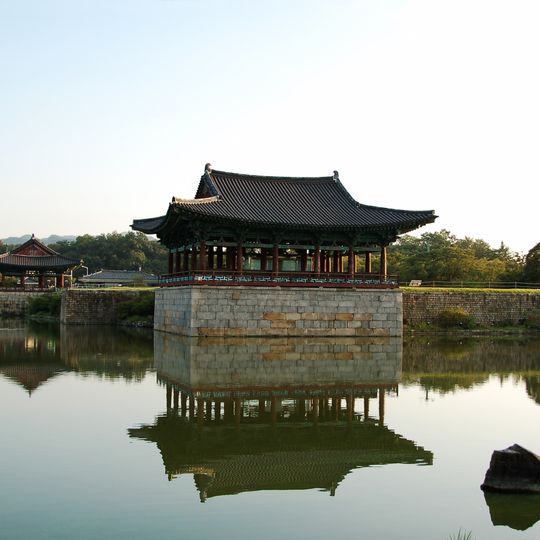
Donggung Palace and Wolji Pond, Royal palace complex in Gyeongju, South Korea.
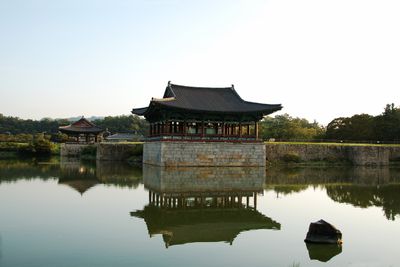
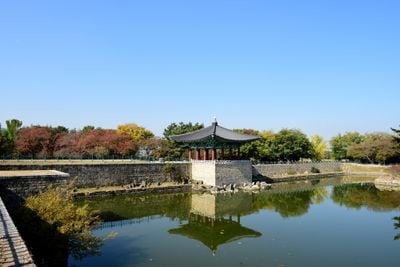
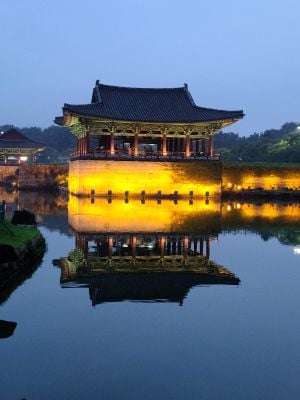
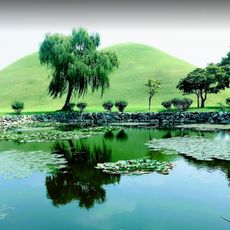
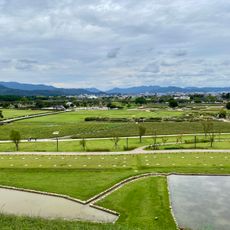
Donggung Palace and Wolji Pond is a Silla-era palace site in Gyeongju, with a rectangular pavilion on a square stone platform rising from the water. The platform is built of light grey stone blocks, and the pavilion has a dark grey tiled hip roof with upturned corners, round dark red columns, and green-painted brackets and beams. The pond measures about 200 m east-west and 180 m north-south and contains three islands.
King Munmu had a large pond dug in 674, right after Silla unified the Three Kingdoms, and in 679 built the Donggung, a separate palace for the crown prince. The pond was later called Anapji, but a pottery shard inscribed "Wolji" found in 1975 restored its Silla name. In 931 King Gyeongsun hosted Wang Geon here as Silla was collapsing.
The name Anapji dates from the Joseon era, when geese and ducks settled on the abandoned pond; a pottery fragment inscribed "Wolji" found in 1975 restored the Silla name. The pond was dug in 674 under King Munmu, and in 931 King Gyeongsun feasted King Wang Geon here as Silla collapsed.
The grounds are lit after dark and open to visitors until 10 PM. Your admission gives you access to the pavilions and the exhibition hall where recovered items are displayed.
The pond's water entered through a channel called Yongyeon in the northeast, where a rough bed filtered impurities before the water fell like a waterfall, showing advanced Silla landscaping. Excavations also uncovered a flush toilet with a sloped drainage channel and tile flooring, indicating high-status hygiene in the royal palace.
The community of curious travelers
AroundUs brings together thousands of curated places, local tips, and hidden gems, enriched daily by 93,465 contributors worldwide.