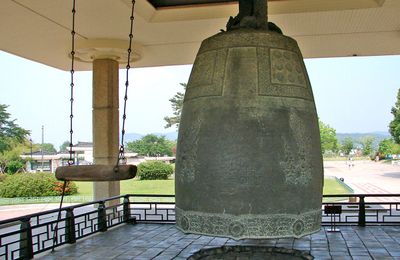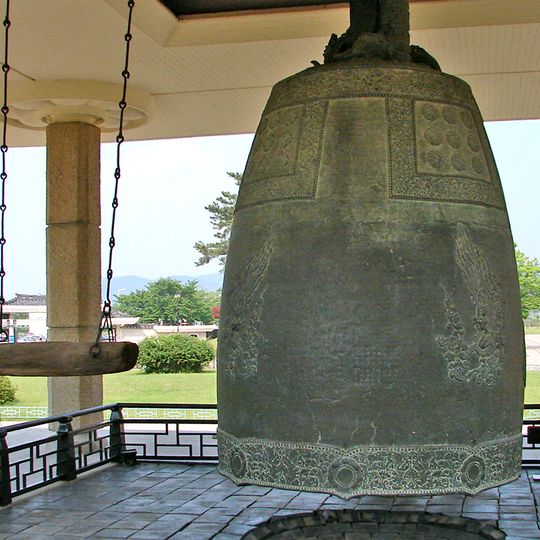
Bell of King Seongdeok, Bronze bell in Gyeongju National Museum, South Korea.
The Bell of King Seongdeok is a bronze bell 3.66 metres tall with a 2.27-metre lip diameter, hanging indoors above a tiled floor in the Gyeongju National Museum. A dragon-shaped hook tops it, and a sound tube rises beside the hook. Nine lotus buds sit in a bordered panel on the upper body, a scrollwork band with medallions rings the rim, and over a thousand Hanja characters are carved on the surface.
King Gyeongdeok began the project in 742 to honor his father, King Seongdeok, but died in 765 before the bell was cast. His son King Hyegong completed it in 771, and it was hung at Bongdeoksa Temple. The temple was lost to a flood of the North Stream between 1424 and 1454, and the bell was moved to Yeongmyosa in 1460, later used to signal the opening and closing of Gyeongju's south gate.
The bell's name comes from the legend of Emille: monks of Bongdeoksa said a child was cast into the molten metal, and the bell rang like a child calling its mother. The story is absent from official histories, and a 1998 analysis found no phosphorus, the main bone component, in the bronze. The bell's sound was used on "No. 29" from BTS's album Arirang.
The bell hangs indoors in the Gyeongju National Museum, so you view it from floor level beneath the open mouth. Walk around the bell to find the dragon-head hook above, the nine lotus buds in their panel, and the two apsaras flanking the lotus striking point. The inscription panels sit on the front and back of the body.
A sound tube (eumtong) rises above the dragon-head hook, a feature found only on Korean bronze bells; it absorbs high frequencies and shapes the beat. The bell hangs from an ancient column that has carried its 18.9 tons for centuries.
The community of curious travelers
AroundUs brings together thousands of curated places, local tips, and hidden gems, enriched daily by 93,467 contributors worldwide.