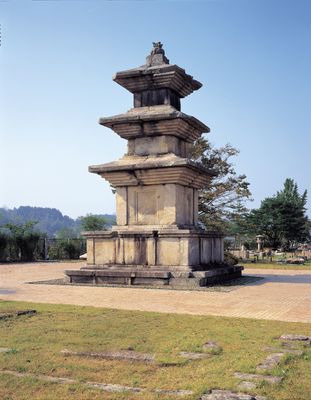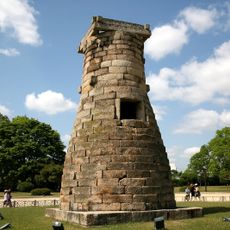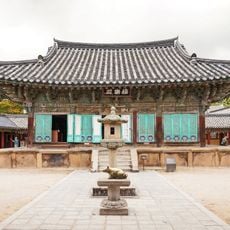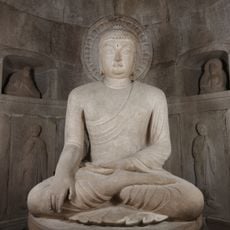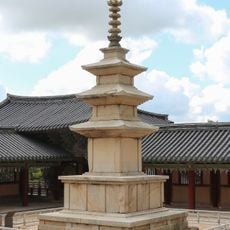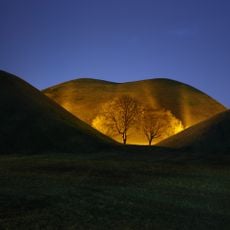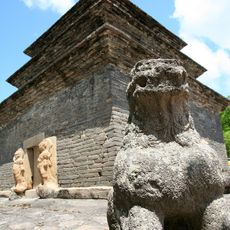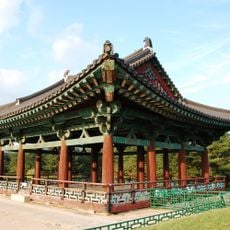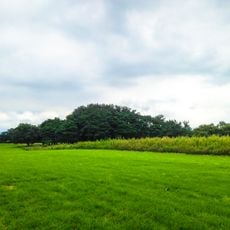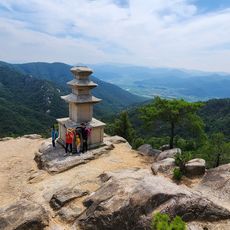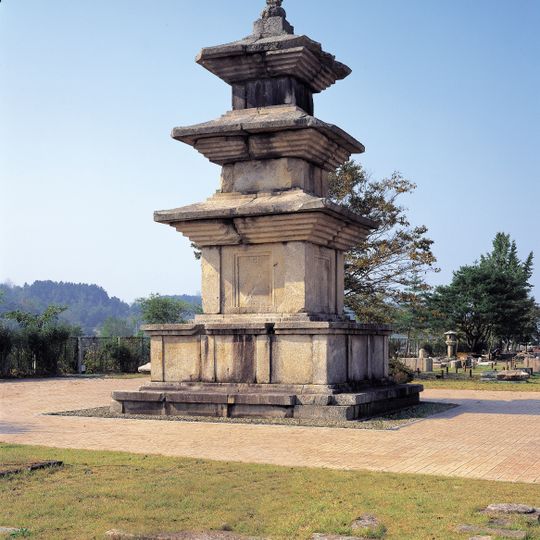
Three-storey Stone Pagoda at Goseonsa Temple Site, Gyeongju, Buddhist stone pagoda in Gyeongju, South Korea.
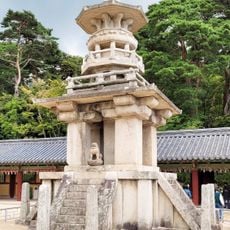
The Three-storey Stone Pagoda is a Buddhist monument made of precisely carved stone blocks arranged in three distinct levels with intricate architectural details. A dual-level base platform supports the three tiers, with each section featuring carefully crafted stonework and decorative elements.
This stone pagoda was built in the late 7th century during South Korea's Silla Dynasty as part of a temple complex. In 1975, it was moved to the Gyeongju National Museum to protect it from repeated flooding that threatened the original site.
The three-tier design reflects Buddhist cosmology, where each level represents a different dimension of spiritual understanding. Visitors can observe how these architectural choices shape the way people engage with the monument today.
The pagoda is housed indoors at the Gyeongju National Museum in a climate-controlled gallery, allowing visitors to examine it from multiple angles. Information panels nearby explain the construction and significance, and visitors can get close to study the carved details and stonework carefully.
The single top stone of this pagoda is one massive block that has rested on the structure below for over 1,300 years, demonstrating remarkable engineering balance. Beneath the roof, five stepped layers support this cap stone in a carefully designed arrangement that has proven remarkably stable through centuries.
The community of curious travelers
AroundUs brings together thousands of curated places, local tips, and hidden gems, enriched daily by 91,669 contributors worldwide.