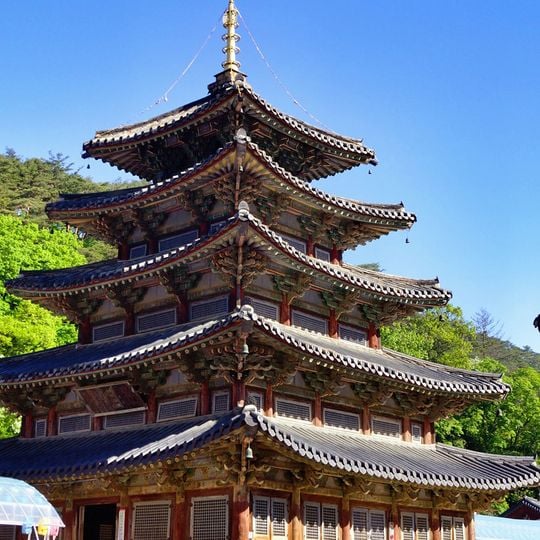
Yeongsanjeon, Buddhist temple at Songnisan National Park, South Korea
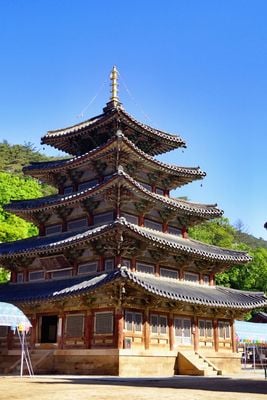
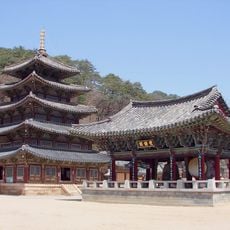
Palsangjeon is a five-storey wooden pagoda in the Beopjusa temple complex on Songnisan. Its dark reddish-brown timber frame has white infill panels and bracket clusters under each of the five roofs, whose upturned eaves step inward to a metal finial. The ground floor has five bays per side, the third and fourth three, the fifth two, and latticed windows sit between corner pillars.
Inscriptions found during the 1968 restoration indicate the hall was first built when Beopjusa was founded in 553. It burned down during the Japanese invasions of 1592–1598. Rebuilding began in 1605 and was completed in 1626, as recorded on a sarira casket and roof discovered in 1968.
The murals inside show eight scenes from the life of the Buddha, from his birth to his passing into Nirvana. Walking through the hall feels like reading a painted story of the Buddhist path, one panel at a time.
The hall stands on a low stone platform with a stepped entrance centred on each of its four sides, so you can walk a full circuit at ground level. Inside, the sarira space, the Buddha shrine and the meditation area are arranged together with the eight painted panels on the four walls. Allow time to look up at the five roof levels, which step inward to the finial.
The 1968 restoration uncovered two inscriptions and a sarira casket that fixed the building's dates: an origin at the temple's founding in 553 and a rebuild finished in 1626, not 1605. At 22.7 m it is the tallest surviving pagoda in Korea. Look for the four Buddha statues inside, each with a different hand position: fearless to the east, teaching to the west, earth-touching to the south, reclining to the north.
The community of curious travelers
AroundUs brings together thousands of curated places, local tips, and hidden gems, enriched daily by 93,498 contributors worldwide.