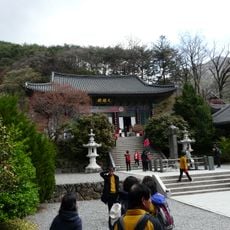
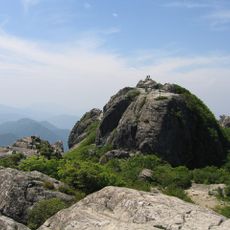
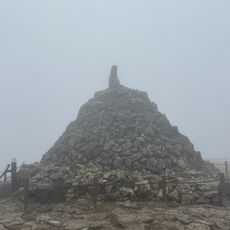
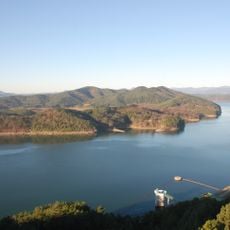
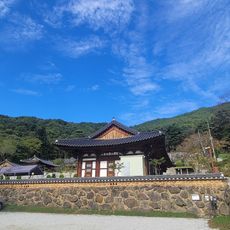
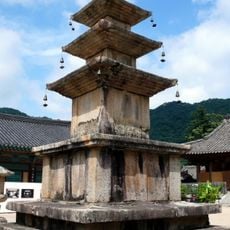
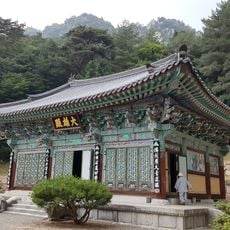
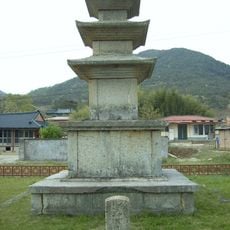
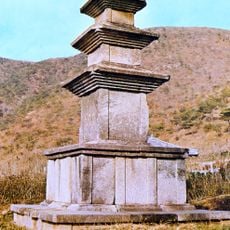
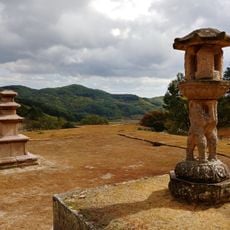
Hwangmaesan, Mountain peak in South Gyeongsang, South Korea.
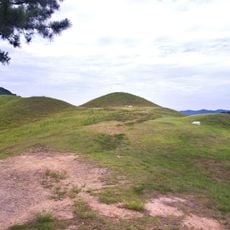
Hwangmaesan is a 1,113-metre mountain on the border of Hapcheon and Sancheong counties in South Gyeongsang Province, made up of diorite and syenite rock. It was designated a county park on 18 November 1983. A road reaches a silver-grass colony at about 900 metres, and the summit area holds the Muhakgul cave and the Deukdobawi rock.
Hwangmaesan was designated a county park on 18 November 1983. The mountain is formed of diorite and syenite; the syenite here consists mainly of plagioclase and hornblende with small amounts of quartz and biotite. Tradition links the Mugakgul cave to the monk Muhak, born in Hapcheon, who is said to have trained there before helping Yi Seong-gye found Joseon.
The name Hwangmaesan means "yellow plum mountain". Legend links the mountain to Muhak, the Buddhist monk who helped Yi Seong-gye found the Joseon dynasty: he was born in Hapcheon County and is said to have practised meditation in Muhakgul cave here. Near the top of Mosanjae, the Doseungdae rock is said to be where the Silla scholar Choe Chiwon trained.
Vehicles can drive up to the silver grass colony at about 900 m elevation, which is why many families visit. Hikers can also walk to the 1,113 m summit. The silver grass is at its best in autumn; the royal azalea bloom draws crowds in spring.
Hwangmaesan was named one of CNN's 50 places to visit in Korea in 2012, and in 2015 the Korea Forest Service listed it among 100 wildflower colony sites. Its silver grass draws crowds in autumn, and vehicles can reach the colony at about 900 m elevation.
The community of curious travelers
AroundUs brings together thousands of curated places, local tips, and hidden gems, enriched daily by 93,490 contributors worldwide.