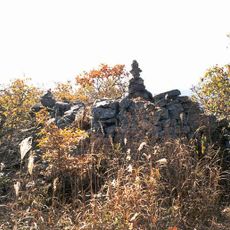
Banyasa, Buddhist temple in Hwanggan-myeon, Yeongdong County, South Korea
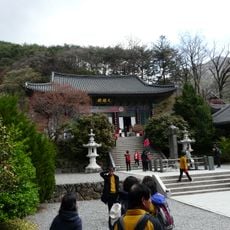
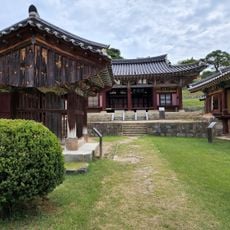
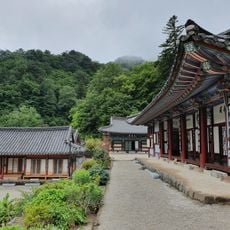
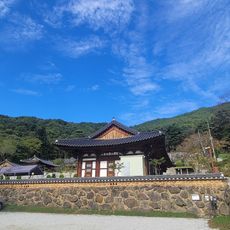
Banyasa is a Jogye Order temple in Hwanggan-myeon, Yeongdong County, North Chungcheong Province. Its main hall, Geungnakjeon, is a three-bay-by-two-bay gabled wooden building without bracket sets, repaired and repainted in recent times. The temple sits on a lotus-bud-shaped rise where the Gusucheon Stream bends, and the Munsujeon Hall stands at the edge of a 100-meter cliff above the water.
Banyasa, in Hwanggan-myeon, Yeongdong County, North Chungcheong, is said to have been founded in 720 by Wonhyo or by Sangwon, one of Uisang's ten major disciples, though no records confirm this. Another account credits National Preceptor Muyeom, who sent the novice Sunin to expel an evil dragon from a pond and filled the pond to build the temple. King Sejo later had it rebuilt and gave it its name.
The temple's name comes from a plaque King Sejo wrote after his skin ailment healed, as he believed, through the blessing of the child Manjusri; the plaque is said to be kept at Banyasa. The temple belongs to the Jogye Order and runs temple stay programs where visitors learn Buddhist practice.
Banyasa sits in Hwanggan-myeon, Yeongdong County, North Chungcheong Province, not in South Gyeongsang. The temple grounds are reached by road up the Seokcheon Valley; the Munsujeon Hall stands at the edge of a 100-meter cliff above the stream, so watch your footing there. Temple-stay programs for Korean visitors are run on site.
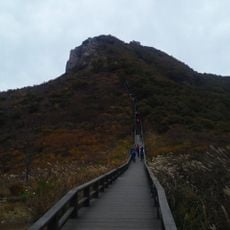
Behind the main hall, a 300-metre rock slide forms the outline of a tiger walking with its tail raised. Yeongdong County built a photo zone there so visitors can frame the tiger shape, set in the Baekdu-daegan range.
The community of curious travelers
AroundUs brings together thousands of curated places, local tips, and hidden gems, enriched daily by 94,455 contributors worldwide.