Ulsanbawi, Protected rock formation in Seoraksan National Park, South Korea
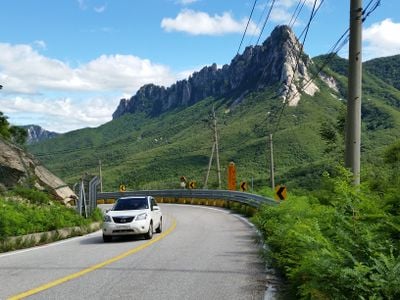
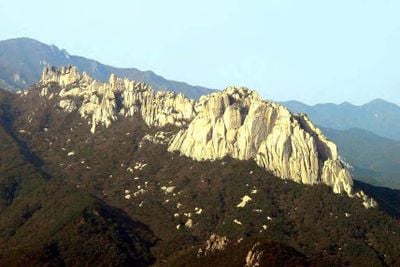
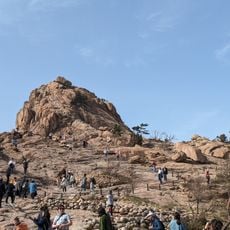
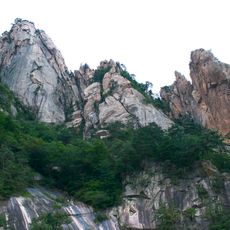
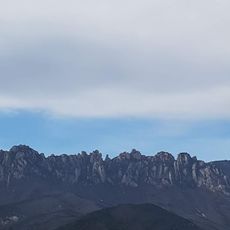
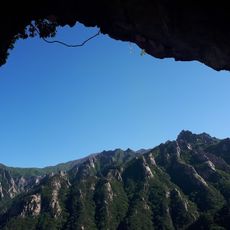
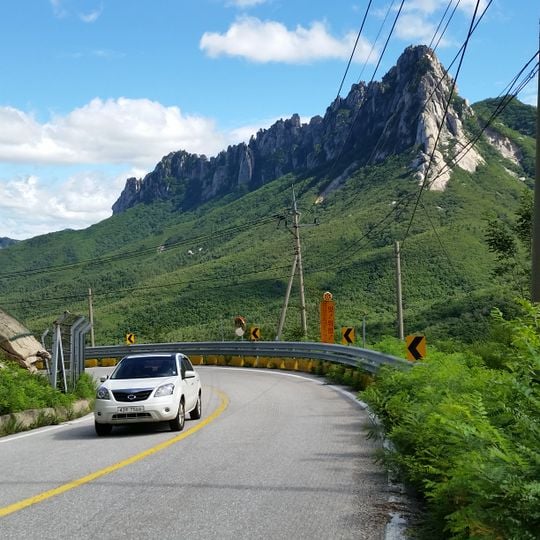
Ulsanbawi is a granite rock formation in Seoraksan National Park composed of six distinct peaks that rise from the surrounding terrain. The rock faces display exposed stone with steep angles, creating a dramatic vertical profile visible from multiple vantage points along the hiking trail.
Ulsanbawi is a granite massif of six peaks that was designated a South Korean scenic site (myeongseung) No. 100 on 11 March 2013. Its Sokcho Granite dates to the Late Cretaceous, about 86–90 million years ago, and the 200–300 m cliffs formed along steeply angled shear joints. Joseon-era writers including Ju Sebung, Choe Yeon and Heo Jeok praised the rock in poems, and Kim Hong-do left several true-view landscape paintings of it.
Joseon-era writers such as Ju Sebung, Heo Jeok and Yu Gyeong-si wrote poems about the rock, and Kim Hong-do left several true-view landscape paintings of it. Its name Cheonhusan, 'mountain where a great wind sound rings', comes from the noise the wind makes through five jar-shaped holes at the summit.
The climb to the summit follows a stairway route of roughly 800 steps, gaining about 600 m from the Seoraksan park entrance. The upper section is exposed rock with a handrail on one side; the descent is hard on the knees, so many walkers use poles. Allow several hours for the round trip and start early to avoid afternoon cloud.
The rock's upper section has five jar-shaped hollows, and wind blowing across them produces a sound that gave the formation its old name, Cheonhusan, "mountain where a great wind sounds". Joseon scholar Heo Mok, writing in 1689, counted nine peaks rather than the six usually cited today.
The community of curious travelers
AroundUs brings together thousands of curated places, local tips, and hidden gems, enriched daily by 94,345 contributors worldwide.