Tanbaly-Tas, Petroglyph site in Almaty Region, Kazakhstan.
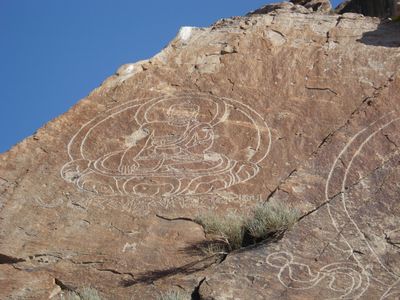
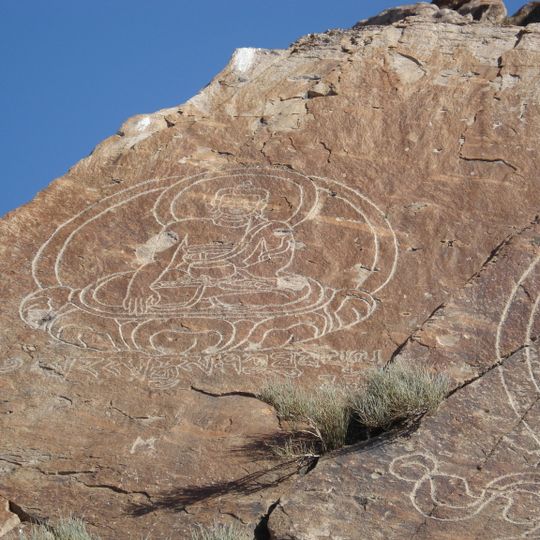
Tanbaly-Tas is a Buddhist open-air temple on the left bank of the Ili River, in the Khabtsagai tract. Its coastal cliffs bear a large iconographic panel of Shakyamuni Buddha, Avalokiteshvara and Bhaiṣajyaguru, accompanied by Tibetan inscriptions, plus separate images of Nageshvararaja and Akshobhya. Tibetan and Oirat prayers are carved on the surrounding boulders.
The open-air Buddhist temple at Khabtsagai, on the left bank of the Ili, was carved in the second half of the 17th century by Tibetan and Oirat masters at the initiative of Galdan Boshogtu Khan. Kazakhs later named the sanctuary Tanbaly-Tas. Study began in the late 19th century: Chokan Valikhanov sketched the area in 1856, and Alexei Pozdneev described the inscriptions in 1899.
The site is called Tanbaly-Tas, "stones with signs", after the marks carved by Kazakh clans. In 1710, during the war with the Dzungars, representatives of the three zhuzes gathered here, pressed their clan tamgas onto felt, and the missing tamga revealed which clan had not sent troops. The same meeting divided summer and winter pastures.
The site lies on the left bank of the Ili River, in the Khabtsagai tract, reached by road from Almaty via the settlement of Iliysk. The soft rock is easily damaged, so stay on established paths and do not touch the carvings. The cliffs face the river and are best visited in dry weather, when the tracks are passable.
The latest inscription is a tall vertical Oirat cursive text carved by Volga Kalmyks who fled to the Ili valley in 1771; N. S. Yakhontova reads it as a thanksgiving to four Buddhas and Avalokiteshvara for deliverance from disease and famine. Two mantras of Manjushri appear although he is not depicted.
The community of curious travelers
AroundUs brings together thousands of curated places, local tips, and hidden gems, enriched daily by 93,729 contributors worldwide.