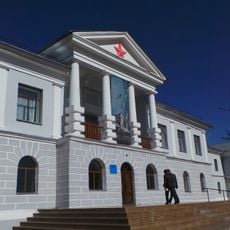
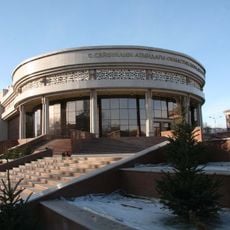
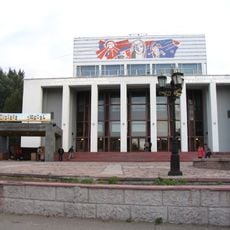
Miners' Palace of Culture, Palace of culture in Karaganda, Kazakhstan.
The Miners' Palace of Culture is a symmetrical three-part building on Bukhar Zhyrau Avenue in Karaganda, with a total volume of 70,000 m³. Its central section holds a theatre complex: a 1,000-seat auditorium, vestibule, upper and lower foyers and side corridors. The main facade has a six-column portico of octagonal columns set against pylons linked by pointed ganch arches, topped by six sculptures.
Construction started in 1940 but was interrupted by World War II, and the building finally opened in 1952. It was built at a time when Karaganda had grown into one of the main coal-mining centers in the Soviet Union.
The portico is topped by six sculptures: a miner, a shepherd, a soldier, a collective-farm woman, an engineer and an akyn. The akyn holds a dombra, the Kazakh string instrument. The auditorium's moulded ornament follows designs by the Kazakh artist Sharil Tugembaev, and the ceiling painting by K. A. Tutevol and Aksenov depicts friendship among nationalities.
The palace stands at 32 Bukhar Zhyrau Avenue, in Karaganda. Its central theatre block was put into use at the end of 1950, and the whole building followed in 1952. The Kazakh Drama Theatre and the Musical Comedy Theatre work on its stage, so check which company performs before planning a visit.
Inside, the railings are made of bronze, the walls are covered in artificial marble, and crystal chandeliers hang from the ceilings, a level of detail that was unusual for a public building at the time. These materials were chosen to signal that culture and workers deserved the same care as any grand civic building.
The community of curious travelers
AroundUs brings together thousands of curated places, local tips, and hidden gems, enriched daily by 95,333 contributors worldwide.