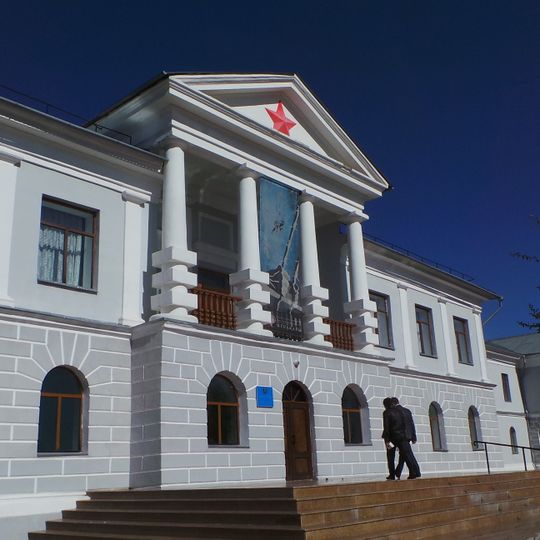
KarLag Museum, Museum of political repression memory in Dolinka, Kazakhstan
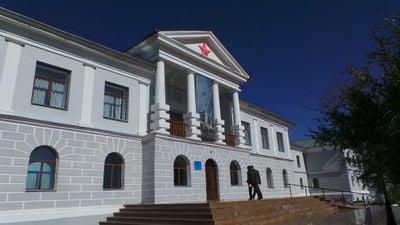
The KarLag Museum occupies the former headquarters of the KarLag camp administration in Dolinka, a settlement in the Shakhtinsk area of Kazakhstan's Karaganda Region. The two-story building has a white facade, a ground floor of light grey rectangular blocks, and a projecting central section with four white columns, a triangular pediment topped by a red five-pointed star, and a recessed balcony with brown wooden railings above a wooden double door reached by broad steps. Its exhibition halls cover the camp's history and the forced resettlement of peoples in the 1930s–1950s.
The museum was created by order of the Karaganda region akim on 24 February 2001 and by decision of the Shakhtinsk city akim on 30 November 2001, following a directive of the President of Kazakhstan; it was registered as a legal entity on 19 March 2002. Until 2011 it occupied part of the Arman outpatient clinic building in Dolinka, a former Karlag facility for civilian employees. On 31 May 2011 it moved into the former Karlag camp administration building.
The museum runs annual commemorations at the "Mamochkino" cemetery, a burial ground closed in the early 1960s and granted memorial-complex status only in 2003. On 21 September 2005 a monument to repressed Ukrainians was unveiled there, honouring among others the Greek Catholic priest Oleksiy Zarytskyi, who died at Dolinka in 1963 and was beatified in 2001 during Pope John Paul II's visit to Ukraine.
The museum is at Shkolnaya 15 in Dolinka, not in Shakhtinsk itself. It moved on 31 May 2011 into the former KarLag camp administration building, where the exhibition occupies 78 m² of a 166.9 m² structure. It is open 9:00–18:00 with Sunday closed; memorial rallies are held at the Mamochkino cemetery.
The museum moved on 31 May 2011 into the former KarLag camp administration building, where the KarITL command that ran the whole camp network of Kazakhstan had its offices. Its collection holds 1,726 items, among them a prisoner's iron bed, a burzhuyka stove and a handwritten camp diary from the 1930s–60s.
The community of curious travelers
AroundUs brings together thousands of curated places, local tips, and hidden gems, enriched daily by 93,466 contributors worldwide.