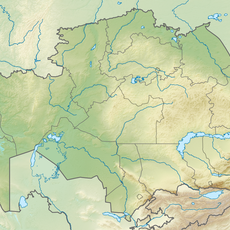
Goose flight, Natural monument and paleontological site near Pavlodar, Kazakhstan.
Goose Flight is a paleontological section on the right bank of the Irtysh in Pavlodar, an 800-meter stretch of slope holding remains of more than 60 vertebrate species of the Hipparion fauna, 4 to 4.5 million years old. Among the finds are Chilotherium, Sinotherium, the sabre-toothed tiger, Lagomeryx, Samotherium and many rodents. Since 2001 it has been a natural monument of republican significance.
Paleontologist Yuri Alexandrovich Orlov discovered bone and teeth fragments in the rock formations here in 1928. The site received official protected status in 1971 to preserve this important scientific resource for future study.
The Kazakh name Қаздар қонысы means "goose settlement", and Russians rendered it as Гусиный перелёт, "goose flight". The site has been a republican-level natural monument since 2001, and in 2019 an open-air museum opened beside the conserved excavation slope. Finds include Chilotherium, Samotherium, Machairodus and Lagomeryx.
The site is open to visitors and has an open-air museum established in 2019 to explain the discoveries. Before visiting, check local conditions since the riverside location can sometimes be affected by weather or water levels.
The fossils date back roughly 4.5 million years and represent one of Central Asia's largest burial sites of Hipparion fauna. This unusual concentration of remains allows researchers to reconstruct a complete picture of the ecological system from that distant past.
The community of curious travelers
AroundUs brings together thousands of curated places, local tips, and hidden gems, enriched daily by 94,365 contributors worldwide.