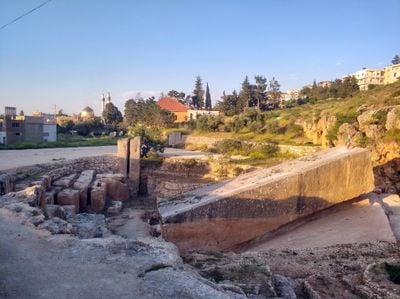
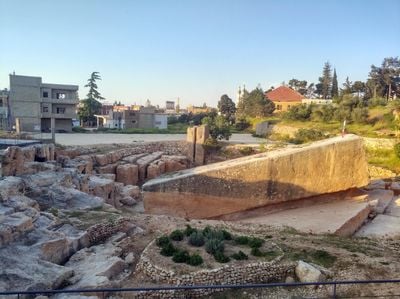
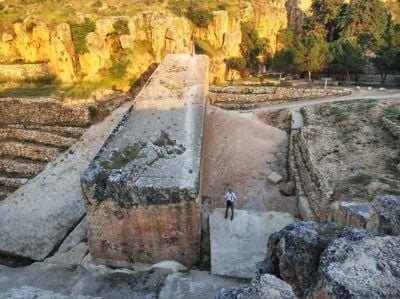
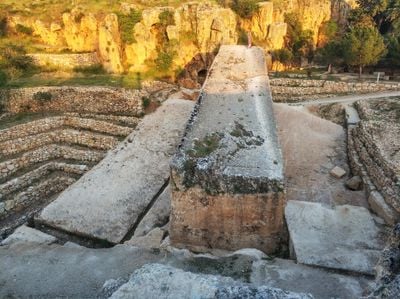
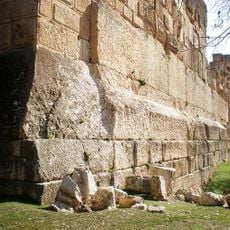
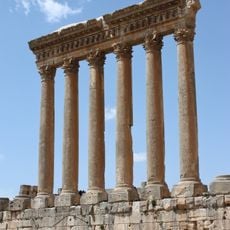
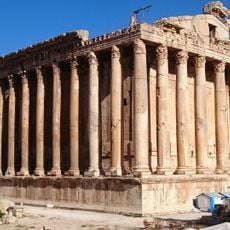
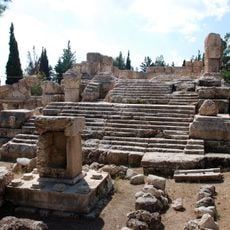
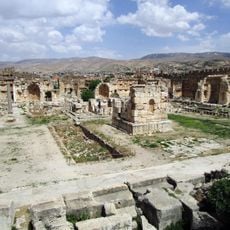
Baalbek Stones, Roman monolith in Baalbek, Lebanon.
The Baalbek Stones are several enormous limestone blocks left in a quarry in Baalbek, Lebanon, never lifted from their original bed. The longest block extends about 20 meters and weighs over 1000 tons, with the surface still showing marks from Roman cutting tools.
Roman engineers began cutting the block for the Heliopolis temple but abandoned the work, leaving the stone in the quarry about 900 meters from the construction site. Archaeologists believe cracks in the rock or logistical difficulties prompted the builders to give up the effort.
The name "Stone of the Pregnant Woman" (Arabic Ḥajar el-Ḥible) carries several explanations: a woman who claimed she could move the block if fed until she gave birth, pregnant jinn tasked with cutting it, or a belief that touching it increases fertility. The Arabic name was earlier Ḥajar el-Qibla, "stone of the south".
The quarry sits open and freely accessible, allowing visitors to view the blocks up close at any time. Visitors should wear sturdy footwear, as the ground is uneven and occasionally covered with loose stones.
The Stone of the South was rediscovered in the 1990s in the same quarry, its location having been forgotten; some sources even confuse its name with that of the Stone of the Pregnant Woman. At about 1,242 tonnes it outweighs the latter, and the Forgotten Stone found in 2014 by the German Archaeological Institute is larger still.
The community of curious travelers
AroundUs brings together thousands of curated places, local tips, and hidden gems, enriched daily by 93,356 contributors worldwide.