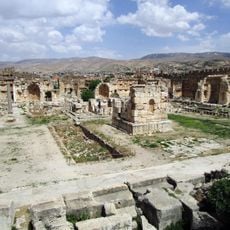
Temple of Jupiter, Roman temple in Baalbek, Lebanon.
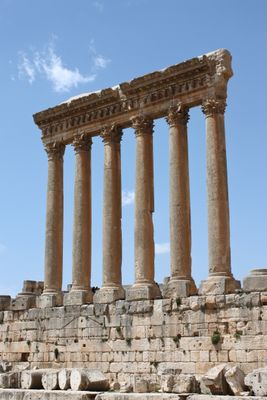
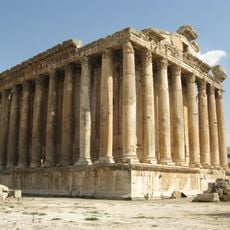
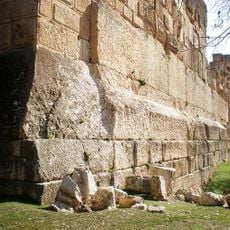
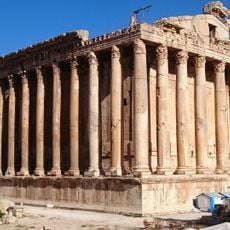
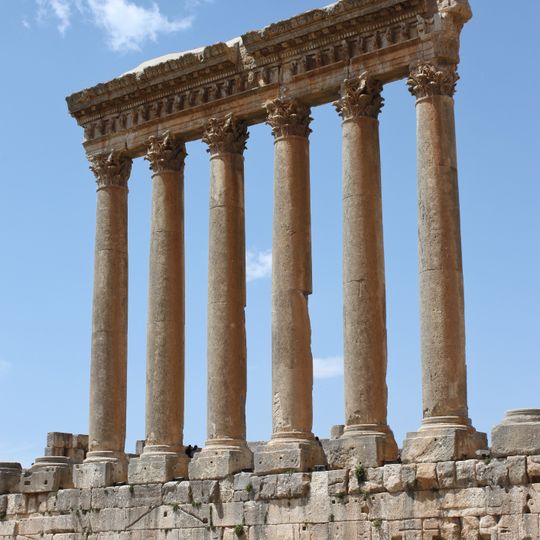
The Temple of Jupiter in Baalbek is a ruined Roman temple whose south side still has six fluted Corinthian columns, 19.9 m high, carrying a carved entablature. They stand on a raised platform above foundation walls built from about 24 monoliths, including the three Triliton stones. The capitals are nearly intact on the south face, while the north faces are worn almost bare by the Beqaa winter winds.
Construction began around 16 BC, when Baalbek became the Roman colony Colonia Julia Augusta Felix Heliopolitana, and was largely completed by AD 60, as a graffito on a topmost column drum shows. Nero added the tower-altar in the mid-1st century, and Trajan added the forecourt with porticos of pink granite from Aswan in the early 2nd century. Earthquakes ruined the sanctuary; under Theodosius and Justinian it was destroyed and pillaged for stone, and eight columns were taken to Constantinople for Hagia Sophia.
The temple shows how Roman worship practices blended with local Phoenician customs, visible today in the stonework and layout of the sacred spaces. Visitors notice how different peoples left their mark on this place over time.
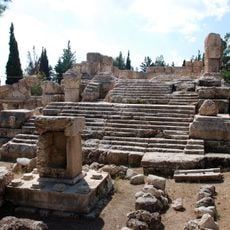
The six surviving columns stand on the south side of the temple platform, reached by a wide staircase from the Great Court. The sanctuary lies on a hill about 1,145 m above sea level, so summers are hot and the open stone gives little shade; mornings are cooler. The Beqaa's winter winds have worn the northern faces of the capitals almost bare, while those on the south remain nearly perfect.
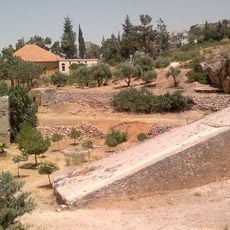
The largest stone blocks in the temple weigh around 800 tons and are longer than a sports field – it is hard to believe people moved these without modern machinery. These colossal stones form the foundation and show the remarkable engineering of the Romans.
The community of curious travelers
AroundUs brings together thousands of curated places, local tips, and hidden gems, enriched daily by 93,506 contributors worldwide.