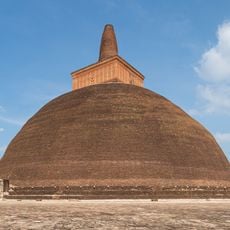
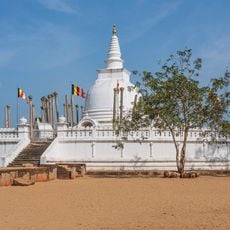
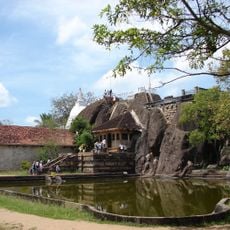
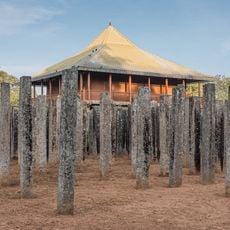
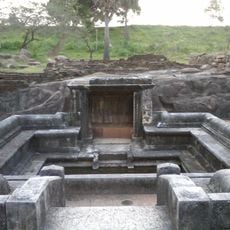
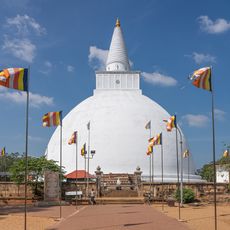
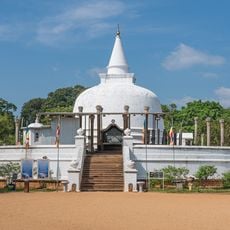
Dakkhina Stupa, Buddhist temple in Anuradhapura, Sri Lanka.
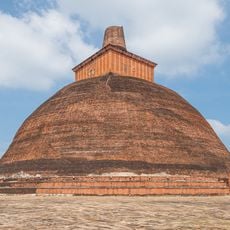
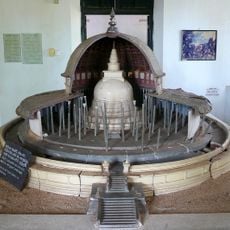
Dakkhina Stupa is a brick Buddhist stupa in Anuradhapura, Sri Lanka, built with three concentric walkways that surround its central chamber. Each walkway sits at a different level, allowing people to circle the structure at varying heights as they move around it.
Local tradition long held this brick mound to be Elara Sohona, the tomb of the Chola king Ellalan, who ruled Anuradhapura for over forty years until about 161 BC. In 1876 the Scottish architect James Fergusson argued it could not be his tomb. Senarath Paranavithana later identified it as the Dakkhina Vihara stupa using a 3rd-century AD Brahmi inscription found between its southern and western vahalkadas. Legend credits its construction to a minister of King Valagamba.
Local Sinhalese and Tamil worshippers long called the mound Elara Sohona, the tomb of King Ellalan, and venerated it as such until the 19th century. The name Dakkhina refers to the ancient Dakkhina Vihara, identified through a 3rd-century AD Brahmi inscription found between the stupa's southern and western vahalkadas.
The mound stands in Anuradhapura's sacred area, near the southern and western vahalkadas whose ground yielded the 3rd-century Brahmi inscription used to identify the site. Approach on foot from the surrounding ruins; the brick terraces are uneven, so watch your footing. Visit early morning or late afternoon to avoid the strongest heat.
Locals long called the mound Elara Sohona, the tomb of the Chola king Ellalan, and both Tamils and Sinhalese worshipped there. In 1876 the Scottish architect James Fergusson argued it could not be Ellalan's tomb; Senarath Paranavithana later identified it as the Dakkhina Stupa using a 3rd-century AD Brahmi inscription found between its southern and western vahalkadas.
The community of curious travelers
AroundUs brings together thousands of curated places, local tips, and hidden gems, enriched daily by 93,465 contributors worldwide.