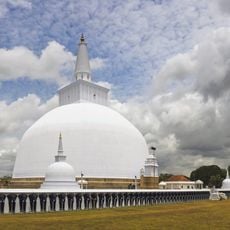
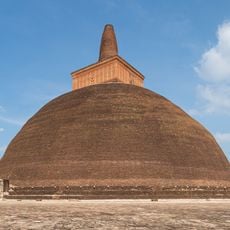
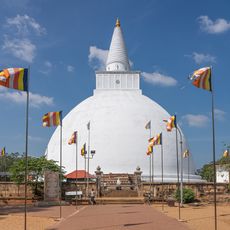
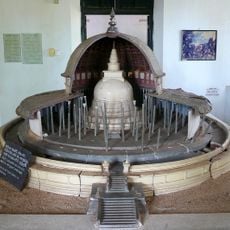
Jetavanaramaya, Buddhist stupa in Anuradhapura, Sri Lanka.
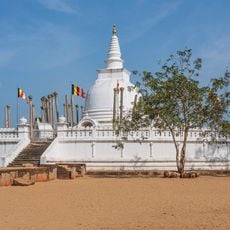
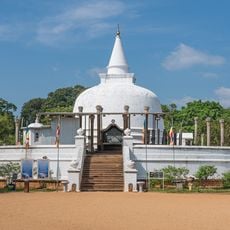
Jetavanaramaya is a monumental Buddhist stupa in Anuradhapura featuring wide stone staircases that lead to a terrace encircling the base of its dome structure. The entire complex rests on an expansive foundation that supports its enormous weight.
King Mahasena (273–301) began the stupa after the Mahavihara was destroyed, and his son Kithsirimevan completed it; it originally stood 122 m tall. Abandoned with Anuradhapura in the 11th century and overgrown by jungle, it was rebuilt by Parakramabahu I in the 12th century to its present 71 m.
The name Jetavana comes from the forest where Mahinda, who brought Buddhism to Sri Lanka, lived and preached. The stupa is a paribhogika relic, believed to enshrine part of the Buddha's girdle. It belonged to the Sagalika sect, linked to Abhayagiri, and later became one of the island's three fraternities until Parakramabahu I abolished it.
The stupa stands in the Jetavana ruins within Anuradhapura's UNESCO-listed old city, reached by road from the town centre. Four flights of stairs, each 9 m wide, climb the sides of the dome. The courtyard shrine's doorpost is 8 m high. The brick dome is unshaded, so visit in the cooler morning or late afternoon.
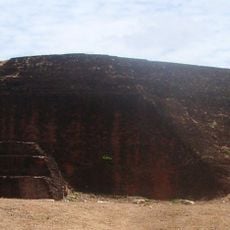
The dome is not hollow: it is a solid mass of full and half bricks with earth fill, shaped as an ellipsoid to spread the load. The bricks, about 93.3 million of them, were made from roughly 60 percent fine sand and 35 percent clay and could bear 44 kg/cm2. The Mahavamsa records that foundation fissures were filled with stone and stamped down by elephants whose feet were wrapped in leather.
The community of curious travelers
AroundUs brings together thousands of curated places, local tips, and hidden gems, enriched daily by 94,670 contributors worldwide.