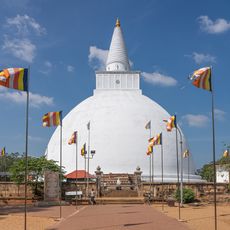
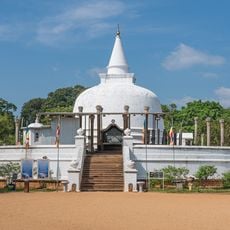
Anuradhapura Museum, Archaeological museum near Ruwanwalisaya Stupa in Anuradhapura, Sri Lanka
The Anuradhapura Museum is an archaeological museum in Sri Lanka housed in a former British colonial administration building. Its collection includes Buddha statues, ancient coins, jewelry, stone inscriptions, and other artifacts spanning different periods of the island's early history.
Dr. Senarath Paranavithana began recording the Department of Archaeology's residual artifact collection on the orders of Commissioner Arthur Maurice Hocart, and the collection was first kept in part of a hospital near Sri Maha Bodhi and Ruwanwelisaya. In 1948, with contributions from S. Shan Muganathan and G. D. Ranasinghe, it was organised as a museum. The government granted the old administration building, but its use as shelter for Anuradhapura flood victims in the 1940s delayed the opening; Governor Nisshanka Wijeratne helped secure two buildings.
The museum keeps the largest inscription collection in Sri Lanka, and its exhibits range from Buddha statues and relic caskets to coins, jewellery, beads, drawings and puppets. Among the models are the Abhayagiri Stupa, the Jantāgara and the Paṁcāvāsa building. The institution is also known by its Sinhala name, Puravidu Bhavana.
The museum occupies the old administration building (parana kachcheri) in the sacred city, next to the Anuradhapura Presidential House and near the Ruwanwelisaya Stupa. It took over two structures: the main grant building and the adjoining two-storey recording building. Allow time for both, since the collection fills several rooms rather than one hall.
The museum holds Sri Lanka's largest collection of stone inscriptions. Among the models on display are the Abhayagiri Stupa, the Jantāgara and the Paṁcāvāsa building, reconstructed in miniature from excavated remains.
The community of curious travelers
AroundUs brings together thousands of curated places, local tips, and hidden gems, enriched daily by 93,527 contributors worldwide.