Hill of Crosses, Religious pilgrimage site in Šiauliai District Municipality, Lithuania
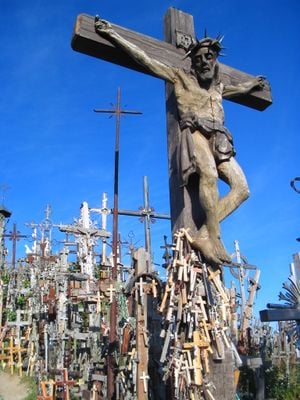
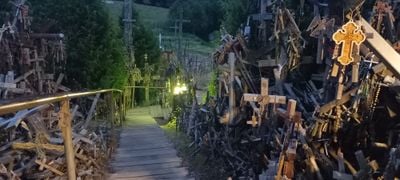
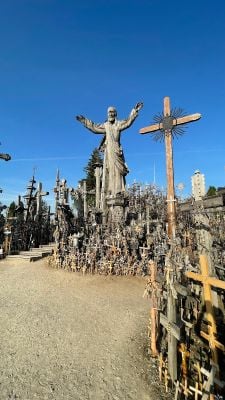
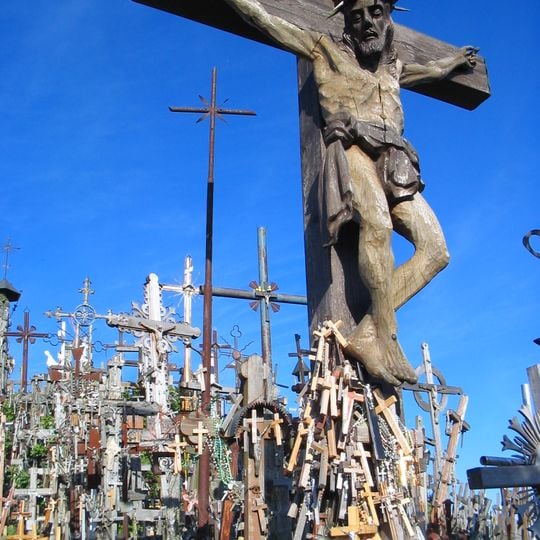
The Hill of Crosses is a pair of low, saddle-shaped hillocks about ten metres high, crossed by a narrow stairway of wooden planks. A large rough-timber crucifix with a pale carved figure of Jesus rises against the sky, while hundreds of smaller metal and wooden crosses, many with radiating spokes or rings, cluster around its base. On one side a dense wall of weathered grey and brown crosses, mostly simple Latin crosses with small carvings or metal fittings, leans and overlaps above head height beside a wooden walkway.
The hill was a medieval hillfort called Jurgaičiai, destroyed by Crusaders in 1348. After the 1831 and 1863 uprisings against Russian rule, families began placing crosses for rebels whose graves they could not find. By 1900 there were 150 crosses, and about 400 in 1940.
Pilgrims leave crosses with a wish or in thanks, most often at weddings, births and Easter; the practice is individual and tied to no fixed date. Lithuanian cross-crafting, kept alive here during the Soviet years, was inscribed by UNESCO on its intangible cultural heritage lists. Small crosses and rosaries hung on larger ones clink softly in the wind.
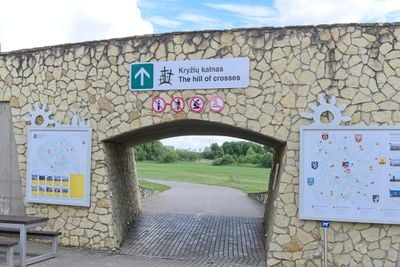
Access remains unrestricted throughout the year with no admission fee, and visitors can purchase crosses from local vendors to add to the collection. The location sits approximately 7.5 miles (12 kilometers) north of Šiauliai along the road to Joniškis.
Soviet authorities destroyed the location multiple times between 1961 and 1975 using bulldozers and burning wooden crosses, yet local residents returned at night to place new ones despite facing arrest and persecution.
The community of curious travelers
AroundUs brings together thousands of curated places, local tips, and hidden gems, enriched daily by 93,340 contributors worldwide.