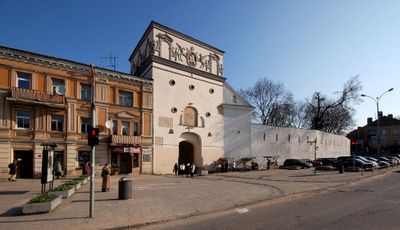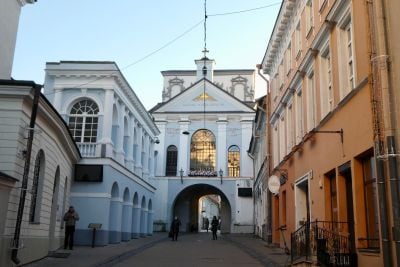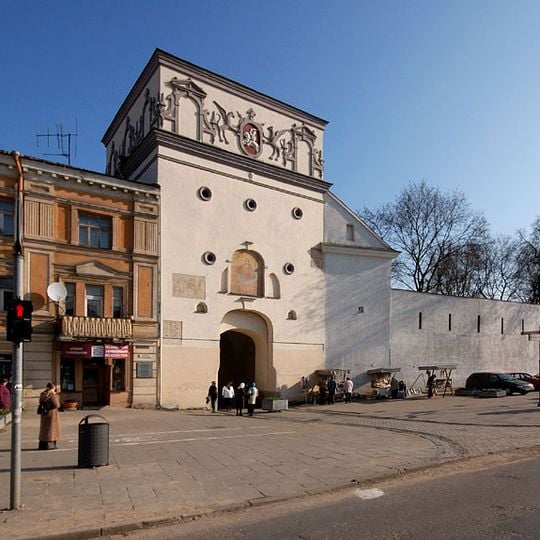
Gate of Dawn, City gate and chapel in Old Town, Vilnius, Lithuania
The Gate of Dawn is a late Gothic gate tower of pale plastered brick, nearly square at 11.2 by 10.8 m with walls up to two metres thick, built 1503–1514. Its ground floor holds a cross-vaulted passage open to north and south; the upper storey carries a full attic with a relief frieze of Dutch strapwork and a medallion of the Lithuanian Pogoń rider. A neoclassical chapel, added to the north side in 1829, closes the inner face.
The gate was built between 1503 and 1514 as part of Vilnius's city wall, first mentioned in a 1503 privilege by King Alexander Jagiellon. It served as the Medininkai Gate, leading south to Medininkai. When the walls were demolished between 1799 and 1805, the gate was left standing because the image of the Virgin Mary had become highly venerated. A wooden chapel was added in 1672, replaced in brick after a 1711 fire.
The chapel draws visitors and pilgrims who come to light candles and spend quiet moments in contemplation before the sacred image. The space remains a living place of devotion where people from different backgrounds gather in shared spiritual respect.
The gate is located at Ausros Vartu 14 in the Old Town and is accessible on foot with an easy entrance. Visitors should dress respectfully as it remains an active place of worship where prayers are held throughout the day.
The painting is on oak boards and measures 200 by 165 cm; its author is unknown. Some attribute it to Łukasz, a Kraków artist who painted a similar work in 1624 for the Corpus Christi Church there, while others link both to a painting by the Flemish artist Martin de Vos from around 1580. Around 1671 the image was covered with a silver, gilded dress.
The community of curious travelers
AroundUs brings together thousands of curated places, local tips, and hidden gems, enriched daily by 94,687 contributors worldwide.