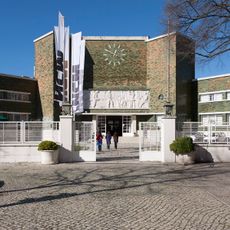
Church of São João de Deus, Catholic church in Praça de Londres, Areeiro district, Lisbon, Portugal.
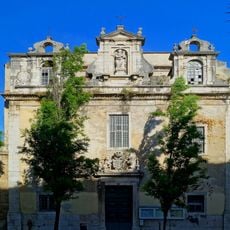
The Church of São João de Deus on Praça de Londres has three separate naves that converge obliquely on the main altar. Two slender, castle-like towers with pyramidal tops flank the main portal, while a wider, recessed tower lights the core. Each nave opens through large pointed-arch doors; the central arch alone carries slight ornament, and sculptor Leopoldo de Almeida's figures of two archangels and the patron saint hang on the plain wall above.
The church was built in 1953 by architect António Lino during the expansion of the Avenidas Novas residential area. This project was part of Lisbon's growth at that time with a focus on modern urban design.
The church is also known locally as the Igreja dos Santos Enforcados, a nickname that arose from the sculpted pomegranates flanking the patron saint on the facade, which popular imagination read as hanged figures. The pomegranate is the emblem of São João de Deus, who is said to have received one from the Christ Child.
The church faces Praça de Londres, where the Rua Alves Torgo and the old Estrada das Amoreiras converge; the Praça de Londres metro station on the Green Line is a short walk away. The three naves each have their own large ogival door from the square, so entry is possible through any of them. The lower floor, equal in area to the whole church, holds two rooms with built-in stages.
The three naves converge obliquely on the main altar, and the interior lighting comes from a wide tower set back behind the two slender, castle-like towers crowned with pyramids that flank the main portal. Stone reliefs of pomegranates around the patron saint's figure recall the pomegranate he received from the Christ Child, a detail that gave the church the popular nickname "Igreja dos Santos Enforcados".
The community of curious travelers
AroundUs brings together thousands of curated places, local tips, and hidden gems, enriched daily by 93,252 contributors worldwide.