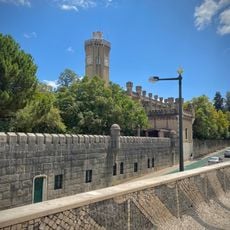
Igreja de Nossa Senhora de Fátima, Gothic Revival church in Avenidas Novas, Portugal
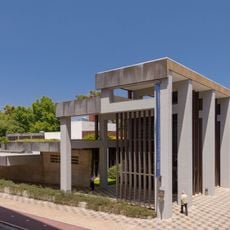
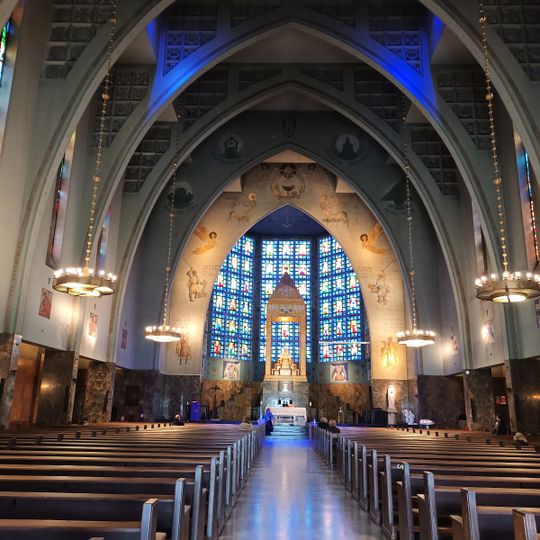
Igreja de Nossa Senhora de Fátima is a modernist Catholic church in Lisbon's Avenidas Novas, designed by Porfírio Pardal Monteiro and built from 1934. Its reinforced-concrete structure is left exposed inside, with rhythmic porticoes like blades shaping the volume. The main nave, about 18 metres wide and seating 800, has a flat terrace roof and is flanked by lower side naves, a baptistery and a single asymmetrical bell tower.
Construction took place from 1934 to 1938, making it the first religious structure built after Portugal's Republic was founded. The building received the Valmor Prize, marking a turning point in the nation's ecclesiastical architecture.
The church holds works by several Portuguese modernists: a frieze of the Apostles by Francisco Franco over the entrance portico, stained glass by Almada Negreiros, a Virgin and the Fatima shepherds plus São João Baptista by Leopoldo de Almeida, and murals of the via sacra by Henrique Franco. Lino António's frescoes in the arches and high choir are considered the first frescoes in a modern public building in Portugal.
The church faces Avenida de Berna, with the main entrance on the east side and the bell tower on the right. The site is bounded by Avenida Marquês de Tomar, Avenida Barbosa du Bocage and Rua Poeta Mistral. The interior is reached through a narthex leading only to the central nave; the baptistery and tower are attached to the right.
The church's sculptural programme is easy to miss: Francisco Franco carved the frieze of the Apostles above the entrance portico, while Lino António painted the frescoes of the arches and high choir, considered the first frescoes in a modern public building in Portugal.
The community of curious travelers
AroundUs brings together thousands of curated places, local tips, and hidden gems, enriched daily by 94,421 contributors worldwide.