Convent of the Capuchos, Franciscan convent in Colares, Sintra, Portugal
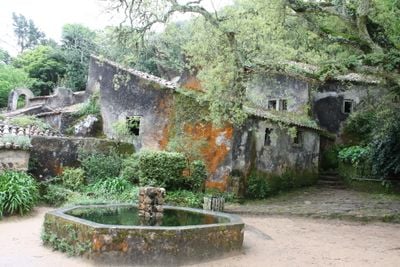
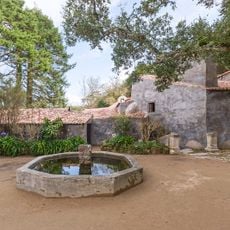
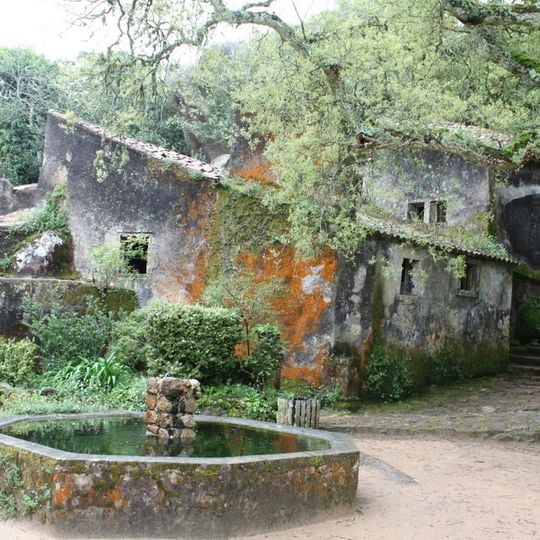
The Convent of the Capuchos is a small 16th-century Franciscan convent on the north slope of the Sintra mountains, its granite quarters fitted among large boulders by friar Pedro de Antória. Its two-storey stone building has a weathered grey facade stained with orange lichen and green moss, a steep tiled roof on the left and a nearly flat lower roof edge on the right. Small grilled windows sit on both sections, and a stone basin with a low rounded rim and short square pillar stands in front.
The convent was founded in 1560 by D. Álvaro de Castro, fulfilling a vow of his father, Viceroy of India D. João de Castro, who died in 1548. Eight friars from Arrábida formed the first community. Portugal's religious orders were abolished in 1834, and the State bought the property in 1949.
The convent embodies a life of simplicity through its design: narrow cells, low doorways, and plain niches shape how the friars spent their days. The architecture itself speaks to a deliberate choice of sacrifice and dedication to spiritual practice.
The monastery sits on a hillside in the Sintra mountains, requiring a walk to reach it, and paths can become slippery after rain. Sturdy footwear and time to navigate the narrow corridors and small rooms are advisable.
The convent's cells have doors covered in cork and lower than a man's height, so that friars had to genuflect to enter. The refectory keeps a large stone slab, given by Cardinal-King Henry, on which the Franciscans ate seated on the floor. After visiting in 1581, Philip I of Portugal said he prized two places in his realms: the Escorial for being so rich and Santa Cruz for being so poor.
The community of curious travelers
AroundUs brings together thousands of curated places, local tips, and hidden gems, enriched daily by 93,790 contributors worldwide.