Khosta Fortress, Medieval fortress near Khosta, Russia
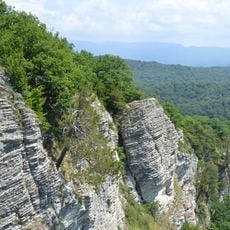
Khosta Fortress is a medieval stronghold built on a steep rocky outcrop that overlooks the surrounding terrain. The stone walls follow the natural contours of the hillside, creating a structure that blends with the landscape.
The origin is disputed. One version links the ruins to a Genoese trading post called Costa, shown on Italian maps of the 13th–15th centuries; another holds that the Byzantine emperor Heraclius I ordered the fortress built in 624, during the Byzantine–Persian war, to cut a Persian-allied mountain tribe off from the sea. Its position 80–90 m above the Khosta, guarding the canyon exit, fits a watch post against attack from the sea.
The name "Genoese fortress" comes from a hypothesis linking the site to the trading post of Costa on 13th–15th-century Italian maps, though the identification is disputed. Excavations on the grounds have yielded fragments of hand-built pottery, including flat-bottomed jar-shaped vessels.
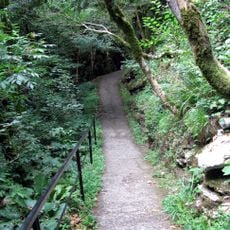
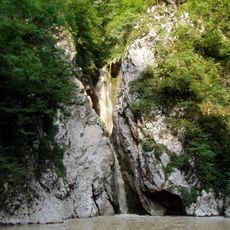
The ruins lie in a hard-to-reach part of the Tiso-Samshitovaya Roshcha reserve, above the right bank of the Khosta, about 6 km from its mouth. Park staff have posted signs forbidding passage and demanding visitors turn back. The path is dangerous, with cliffs and falling rock, so do not go alone.
The walls are built of rough-hewn limestone blocks bound with mortar containing sea sand and river pebbles. Archaeologists found fragments of hand-modelled pottery with porous walls, including flat-bottomed pot-shaped vessels, on the site. Old box trees and hornbeams now grow directly on the wall fragments, high above the ground.
The community of curious travelers
AroundUs brings together thousands of curated places, local tips, and hidden gems, enriched daily by 94,231 contributors worldwide.