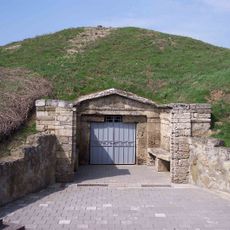
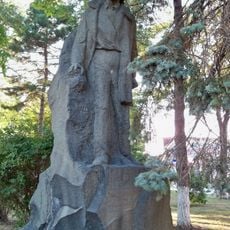
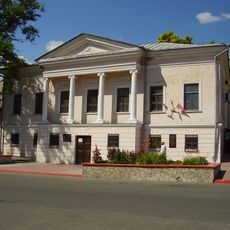
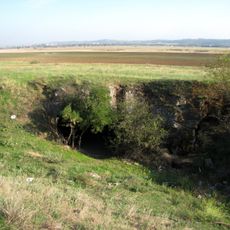
Demeter's Crypt, burial vault in Kerch, Ukraine
The burial chamber is a rectangular room with a rounded vault ceiling decorated with detailed wall paintings from antiquity. The interior measures roughly 2.2 by 2.75 meters and displays the artistic work of ancient craftspeople.
The crypt was discovered in 1894 by the Russian archaeologist Vladislav Shkorpil and dates to the early 1st century AD. The first architectural description was published in 1914 by Mikhail Rostovtsev. From 1926 onward, specialists repeatedly warned that the paintings were deteriorating, and conservation work on the murals began in the late 1980s.
The crypt's name comes from the bust of Demeter in a central medallion, painted with a sad gaze and a necklace, with her name inscribed beside it. The murals illustrate the Homeric hymn to Demeter: Pluto's chariot with four differently coloured horses carries off Kore, while Hermes and the nymph Calypso appear near the entrance. White poppies tied with a ribbon on the north and south walls allude to the same myth.
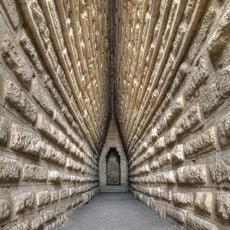
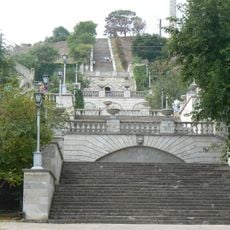
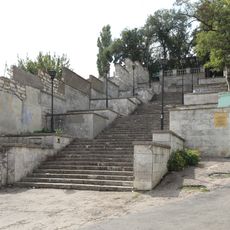
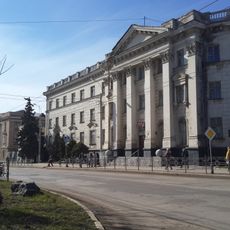
The crypt lies within Kerch's built-up area, sunk about 5.4 m below the surface beside a natural slope, and is reached through a short dromos. The original is closed to visitors; a full-scale model stands at the foot of the Mitridatskaya Stairs. Since 2018 both the crypt and the model have been listed as under threat.
An exact replica opened to the public in 1998, while the original remains accessible only to researchers. This copy preserves the artistic details for future generations to study.
The community of curious travelers
AroundUs brings together thousands of curated places, local tips, and hidden gems, enriched daily by 94,348 contributors worldwide.