Al-Subaie Palace, Archaeological palace site in Shaqra governorate, Saudi Arabia.
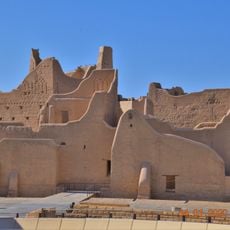
Al-Subaie Palace is a two-storey mud-brick building in Shaqra's old town, with a flat crenellated roofline and vertical corner towers. Its facade rises in stepped sections, the tallest block on the right holding small deep-set windows and a projecting rounded bay. Rows of triangular dentil molding run across the upper walls, and a sign reads "AL-SUBAIE HISTORIC PALACE" beside Arabic script.
Sheikh Abdulrahman bin Abdullah Al-Subaie, agent of the treasury, built the palace in 1358 AH and moved in upon completing it in 1359 AH. King Abdulaziz stayed there for considerable periods on his journeys, including 20 days after the Battle of Sabla. In 1411 AH the Ministry of Education began a radical restoration after cracks appeared, and a further full restoration was approved in 1421 AH after parts collapsed following the rains of 1418 AH.
The rooms display traditional craftsmanship with doors decorated using natural pigments and wood carvings. These handmade details reveal local skills and materials passed down through generations within the region.
The palace stands in the southwest of Shaqra's old town, on the Hafir market road, with a second exit on the north side toward the Qa'ra market. It has two floors and was recently restored by the Agency of Antiquities and Museums, which enclosed it with a protective wall. Approach from the old-town lanes to see the facades and the courtyard.
The roof uses wooden beams layered with palm fronds, mud, and plaster showing regional building techniques from the early 1900s. This construction method was common for buildings in the area and demonstrates how structures adapted to local climate conditions.
The community of curious travelers
AroundUs brings together thousands of curated places, local tips, and hidden gems, enriched daily by 93,364 contributors worldwide.