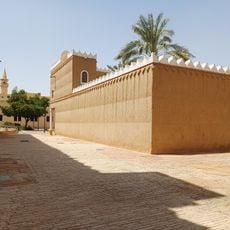
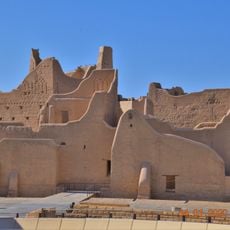
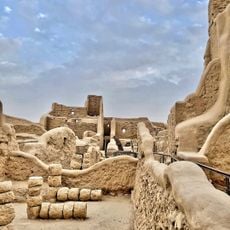
Uqdat al-Jeraisy, Medieval castle ruins in Raghabah, Saudi Arabia.
Uqdat al-Jeraisy is a square mud-brick fortress in the town of Raghabah, about 70 m long and covering 5,000 sq m, with walls over two metres thick. Its four corners carry round towers pierced with openings for watching enemies, and a three-metre gate opens on the west side. Houses stood inside around a small square stone-lined well.
Ali al-Jeraisy built the fortress shortly before 1171 AH (mid-18th century) as the seat of his rule over Raghbah, and it became one of the strongholds of the First Saudi State under Imam Muhammad ibn Saud. Ibn Bishr records that Mubarak ibn Adwan besieged him there and could not storm it. It was destroyed in the early 13th AH century by Husayn Bey, leaving only ruins.
The name Uqdat al-Jeraisy comes from Ali al-Jeraisy, who built the fortress and made it the seat of his rule over Raghabah. Families who lived inside included the al-Jeraisy, Al Huwaimil, Al Jadid and Al Nami. West of the walls lay a hollow, the Uqda pit, where buying and selling took place.
The castle stands in the town of Raghabah in Riyadh Province, on the road toward Al-Majma'ah. The gate opened on the west side, where the ground outside the walls was used as a market area, so approach from that direction to read the layout. The walls were built of mud brick over two metres thick, and only ruins remain after the demolition by Husayn Bey.
Inside the courtyard stood a small square well lined with stone, which supplied water to those sheltering within the walls. West of the castle lay a hollow called the Uqda pit, where buying and selling took place.
The community of curious travelers
AroundUs brings together thousands of curated places, local tips, and hidden gems, enriched daily by 94,679 contributors worldwide.