Stockholm Observatory, Astronomical observatory in Vasastaden, Sweden
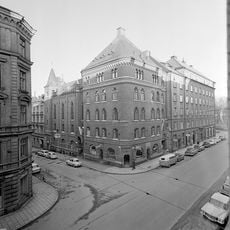
Stockholm Observatory is the Royal Swedish Academy of Sciences' first observatory building, completed in 1753 on Observatoriekullen in Vasastaden. Its tall central block and the circular room whose curve bulges out in the facade give it its character; a dome with a rotating top crowns the building. The Zeiss telescope in the dome, made in 1910, was originally set up at the Skansen observatory.
The Royal Swedish Academy of Sciences established this facility, with construction beginning in 1748 under architect Carl Hårleman's design. It became central to Sweden's scientific work and timekeeping standards during the 1700s and 1800s.
The observatory is named after its hill, Observatoriekullen, not after any monarch; it was founded by the Royal Swedish Academy of Sciences. Its first head, Pehr Wilhelm Wargentin, is called the father of Swedish population statistics. Since 1756 temperature and precipitation have been measured three times daily on the site, now by SMHI, giving the world's longest continuous weather record at one place.
The observatory stands on Observatoriekullen in Vasastaden, reached on foot through Observatorielunden park. The museum inside closed on 4 January 2014, so the building is not open for tours; it now belongs to the city through SISAB and is being opened up for school pupils and teachers. Weather measurements by SMHI continue at the site.
The observatory was once home to Sweden's prime meridian, serving as the reference point for the country's maps and time measurements before international standards took over. This scientific importance made it a crucial landmark for Swedish navigation and timekeeping.
The community of curious travelers
AroundUs brings together thousands of curated places, local tips, and hidden gems, enriched daily by 94,042 contributors worldwide.