Karlberg Palace, Royal palace in Huvudsta, Stockholm, Sweden
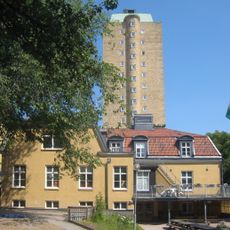
Karlberg Palace stands by the Karlberg Canal in Solna, next to Stockholm's Vasastaden district. Its H-shaped plan, created by Jean de la Vallée after 1669, has two wings and a waterfront terrace, with north wings enclosing a courtyard. The façade preserves red festoon stucco and curved cornices, and the interior has stucco ceilings by Carlo Carove.
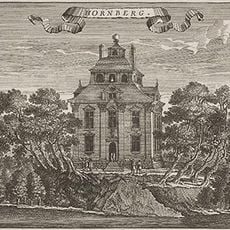
In the 1620s Lord High Admiral Carl Carlsson Gyllenhielm bought the villages Ösby, Bolstomta and Lundby and merged them into an estate named after himself. Master mason Hans Drisell built a Renaissance palace with pink plaster and tall gables; a larger stone house followed in 1634. In 1669 Magnus Gabriel De la Gardie bought it and had Jean de la Vallée rebuild it as an H-shaped palace with a church in the east wing. In 1688 it passed to the crown, and in 1792 the Royal War Academy moved in.
The palace has housed the Royal War Academy, now the Military Academy Karlberg, since 1792, training about 300 officers and officer cadets a year. Queen Ulrika Eleonora's tapestry school for orphaned girls, Tapetskolan vid Karlberg, also operated here, and her son Charles XII took charge of it after her death in 1693.
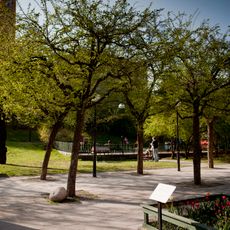
The palace park is open daily from 6 AM to 10 PM, while the palace itself remains a military institution and is not open to the public. The park can be reached from Vasastaden via Karlbergsvägen and the Karlberg Canal.
Pompe, Charles XII's dog, died at Karlberg in 1699 and is buried in the park; two later dogs with the same name died in Poland in 1703 and Hungary in 1714. The Temple of Diana, built 1790–1792 by Carl Christoffer Gjörwell for Gustav III, was originally dedicated to Neptune, and its current name likely stems from confusion with De la Gardie's hunting temple Dianeberg.
The community of curious travelers
AroundUs brings together thousands of curated places, local tips, and hidden gems, enriched daily by 93,455 contributors worldwide.