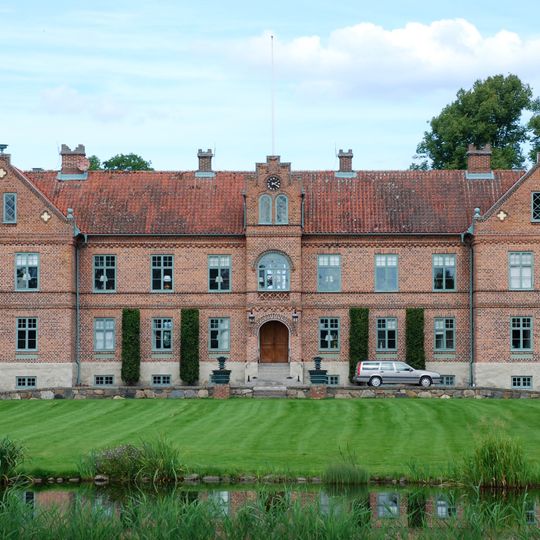
Hanaskog Castle, Manor house in Östra Göinge Municipality, Sweden.
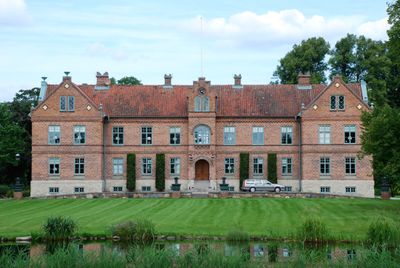
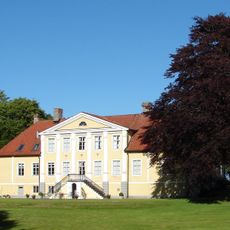
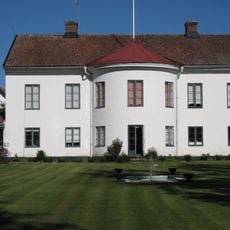
Hanaskog Castle is a three-storey red-brick manor house in Östra Göinge Municipality, Sweden. Its facade has a projecting central section with a round-arched doorway and fanlight, a balcony above, and a round window near the roofline. Two long wings and slightly projecting end sections flank the centre, under a steep red tile roof with chimneys, two dormers and a flagpole.
The estate has roots going back to the medieval period, but its present shape comes from work commissioned after Count Carl Axel Wachtmeister acquired it in 1827. Architect Hans Jakob Strömberg then gave the building the form it still holds today during renovations carried out in the 1850s.
The name Hanaskog comes from the estate itself, and the Swedish form Hanaskogs slott is still used locally. The house passed from Count Carl Axel Wachtmeister to Baron Gerhard Louis De Geer in 1891, linking it to a family that also held the Vanås fideicommission and the office of Prime Minister of Sweden.
The estate sits in a rural part of southern Sweden and is hard to reach without a car, since public transport in this area runs infrequently. Once there, sturdy footwear helps when walking the grounds, as the paths between the forested areas and open fields can be uneven.
The De Geer link runs through the mother: Gerhard Louis was the son of Countess Karolina Lovisa Wachtmeister, whose family had bought Hanaskog in 1827. He took over the estate in 1891 while serving as governor of Kristianstad County, and his father, Louis Gerhard De Geer, had been Sweden's first prime minister from 1876 to 1880.
The community of curious travelers
AroundUs brings together thousands of curated places, local tips, and hidden gems, enriched daily by 94,705 contributors worldwide.