Sinclairsholm Castle, 17th-century château in Hässleholm Municipality, Sweden.
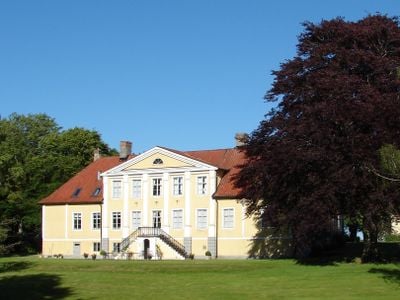
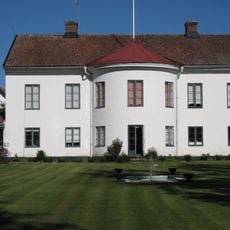
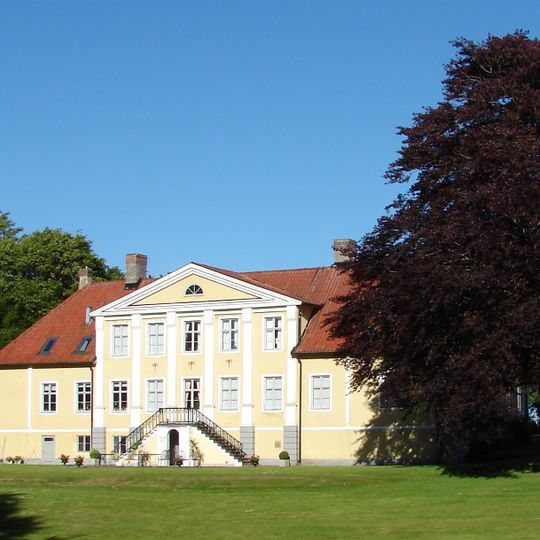
Sinclairsholm Castle is a two-story building with a pale yellow facade and white trim, its central section stepped forward under a triangular pediment with a small semicircular window. Symmetrical rows of tall rectangular windows with white frames line the facade, and an arched doorway at the center is reached by a double staircase with dark railings. A red tile roof with two pale chimneys tops the building, while a taller yellow wing with red roofing rises to the left.
Andrew Sinclair, Danish privy counsellor and governor of Landskrona Castle, founded the estate and in 1620 exchanged land with the parsonage to obtain the building site. The house was completed in 1626, as an inscription above the door records, but Sinclair died in 1625 and his son Kristian took over. The Skytte family held the estate until 1808, when it passed to the Gyllenkrook family.
Swedish botanist Carl Linnaeus visited Sinclairsholm Castle in May 1749 during his scientific expedition through the Scania region.
The castle remains privately owned and is accessible to visitors, but only by prior arrangement and upon request for guided tours. It is advisable to make contact in advance to schedule a visit.
Swedish naturalist Carl Linnaeus visited the estate in May 1749 during his scientific expedition through the region. This visit connects the castle to one of Europe's most important natural scientists.
The community of curious travelers
AroundUs brings together thousands of curated places, local tips, and hidden gems, enriched daily by 94,654 contributors worldwide.