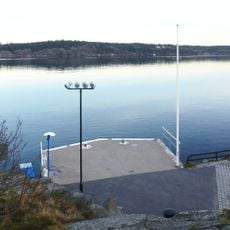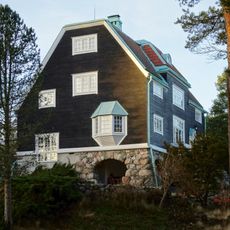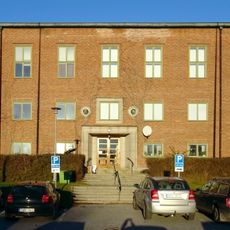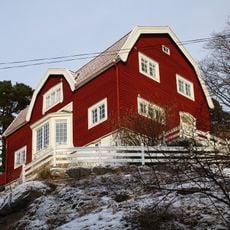
Saltsjöbaden Observatory, Astronomical observatory in Saltsjöbaden, Sweden.
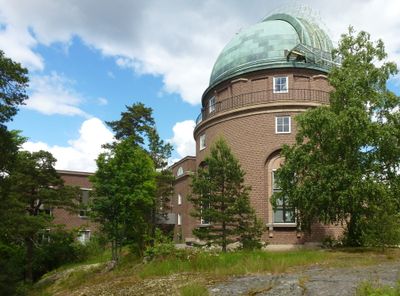
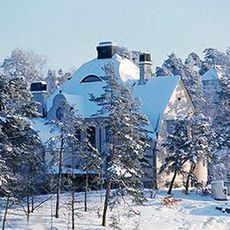
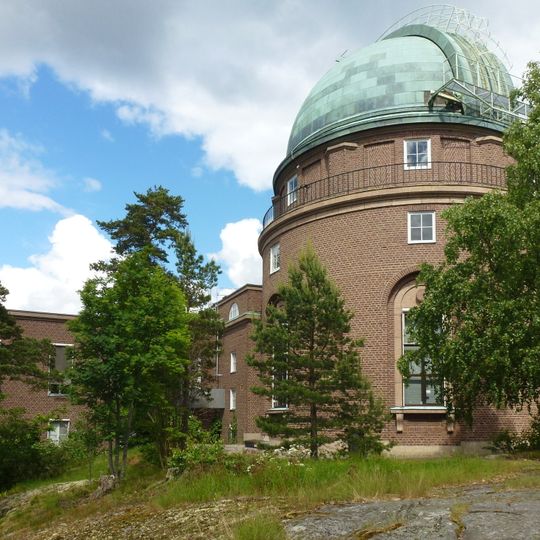
Saltsjöbaden Observatory is an astronomical complex near Stockholm built on elevated terrain with two large telescope domes and supporting structures. The main facility sits roughly 50 meters above sea level, taking advantage of its hilltop location for clearer views of the night sky.
The old Stockholm Observatory had become outdated and hampered by city light, so in 1926 astronomer Nils Nordenmark called for new equipment. Bank director Knut Wallenberg backed the plan, and the academy chose Karlsbaderberget in Saltsjöbaden, south-east of the city, for its dark southern horizon and clearer coastal skies. Construction began in 1929 to designs by Axel Anderberg, and the new observatory opened on 5 June 1931 in the presence of King Gustaf V, keeping the name Stockholm Observatory. Research moved to Albanova in 2001.
The observatory kept the name Stockholms observatorium as a condition of the Wallenberg foundation's funding, and Bertil Lindblad led its research from 1931. Since 1964 the Stockholms Amatörastronomiska Klubb, later Stockholms amatörastronomer (STAR), has used two of the side domes; Ericssons astronomiförening has also worked here.
The site is now occupied by Kunskapsskolan Saltsjöbaden and its science centre, so the buildings are school premises rather than a public museum; visits depend on the school. The observatory stands on Karlsbaderberget in Saltsjöbaden, southeast of Stockholm, and the two side domes have housed the Stockholm Amateur Astronomers (STAR) since 1964.
The 1963 Schmidt telescope with its 1-metre mirror is no longer in use, while the 40-inch Grubb & Parson reflector in the eastern 12-metre dome and the 50/60 cm double refractor in the main building still work. Asteroid 36614 Saltis, discovered here in 2000, is named after Saltsjöbaden.
The community of curious travelers
AroundUs brings together thousands of curated places, local tips, and hidden gems, enriched daily by 93,453 contributors worldwide.