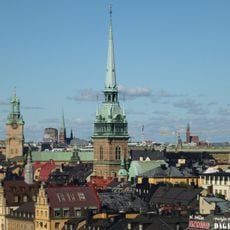
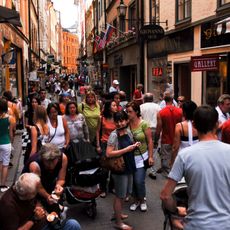
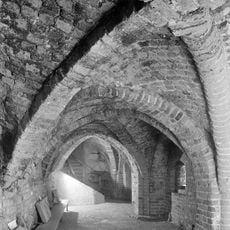
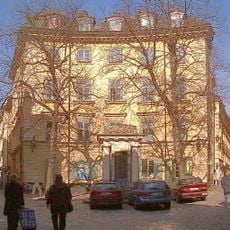
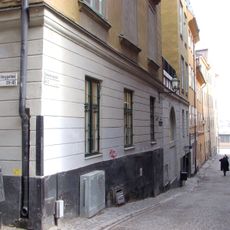
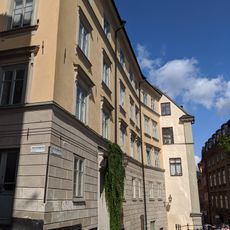
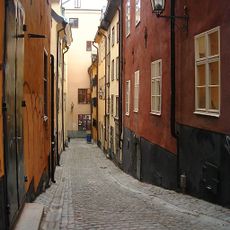
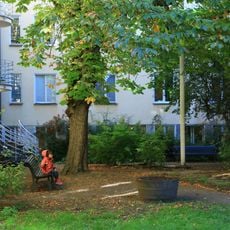
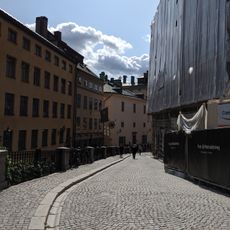
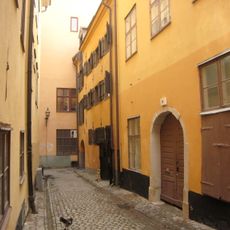
Svartmangatan, Medieval pedestrian street in Gamla Stan, Stockholm, Sweden.
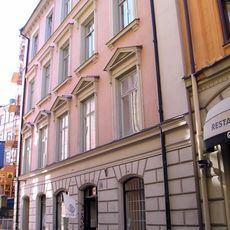
Svartmangatan is a street in Gamla Stan that runs southeast from Stortorget to Södra Benickebrinken, crossed by Kindstugatan, Tyska Skolgränd, Tyska Brunnsplan, Själagårdsgatan, Tyska Stallplan and Baggensgatan. It runs parallel to Skomakargatan and Prästgatan. The Rococo building at number 17, built in 1768 for the German Church, has rounded corners.
Svartmangatan is first mentioned in 1437 as the path from Stortorget to the Blackfriars' monastery. In the 15th century it appears as Svartbrödragatan and Svartmunkegatan. During the 17th century the prefix changed to Svartman-, likely by analogy with Köpmangatan, since there is no record of Dominicans being called "black men".
The name comes from the Blackfriar monastery at the street's southern end. Until the 17th century it was called Svartmunka- or Svartbrödragatan, after the black-robed Dominicans. Since no record calls the friars "black men", the change to Svartman- is thought to mirror Köpmangatan, another street from Stortorget.
Svartmangatan runs southeast from Stortorget to Södra and Norra Benickebrinken, crossed by Kindstugatan, Tyska Skolgränd, Tyska Brunnsplan, Själagårdsgatan, Tyska Stallplan and Baggensgatan. It is a walking street, so plan your route on foot; the surface is cobbled and uneven in places, and comfortable shoes help.
The name Svartmangatan does not come from the Dominican friars, who were never called "black men" in records. Linguists instead link it to Köpmangatan, the "buyer-man street" also leading from Stortorget, by analogy.
The community of curious travelers
AroundUs brings together thousands of curated places, local tips, and hidden gems, enriched daily by 94,006 contributors worldwide.