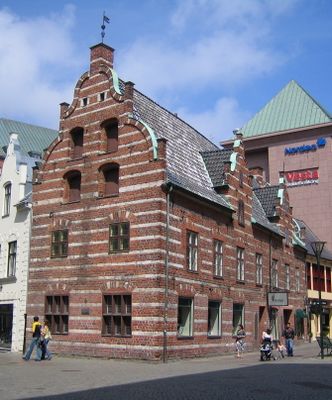
Flensburgska huset, 16th-century architectural ensemble in Malmö Centrum, Sweden.
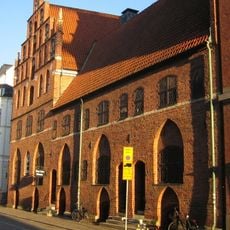
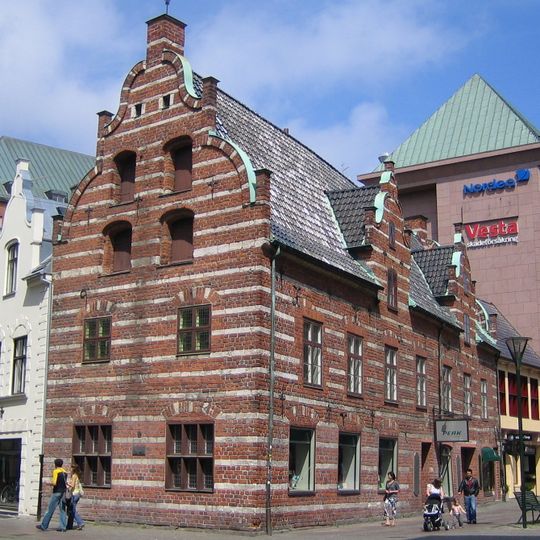
Flensburgska huset is a tall brick building on Södergatan in Malmö, its stepped gable banded with alternating red brick and pale limestone. The steep roof has dark tiles and small dormer windows; the gable rises to a finial. Windows sit in dark brick surrounds, with two arched windows near the top and white-framed rectangular windows below. A green "PARK" sign is mounted at street level.
The Swedish source dates the house to 1595, when councillor Helmicke Ottesen had it built; a Danish source says 1596. In the early 1600s it passed to Söfren Christensen, who had herded sheep at Skabersjö Castle as a child and died in 1651 as Malmö's mayor and richest resident. Merchant Mathias Flensburg bought it in 1827 for use as a warehouse, and Eva Flensburg donated the whole property to Malmö Museum in 1964 or 1965.
Söfren Christensen's 1651 estate inventory lists 23 paintings in the upper great and small halls, including a royal portrait, and portraits of dead relatives in his son Harche's room. His large epitaph, showing him with his whole family, survives in Sankt Petri Church. The house is now the office of Malmö's culture administration.
The building sits on Södergatan street in the old town and has been legally protected since 1968, making it easy to view the architecture from outside. It works well as a stop on a walking tour through central Malmö to appreciate historical construction details.
Residents in the 1800s mistakenly called it Klostermagasinet, thinking it housed a former monastery, even though it was built well after the Reformation. This confusion shows how local memory can attach different stories to historic buildings.
The community of curious travelers
AroundUs brings together thousands of curated places, local tips, and hidden gems, enriched daily by 95,017 contributors worldwide.