Horn, Manor house in Södertälje Municipality, Sweden.
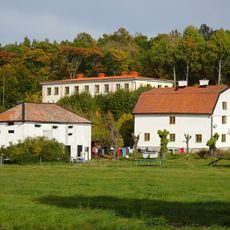
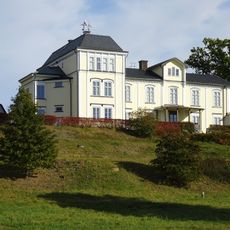
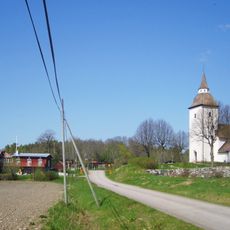
Horn is a former säteri and estate in Överenhörna socken, Södertälje Municipality, at the northern tip of Enhörnalandet just north of Överenhörna Church. Its main building is a two-storey timber house with seven window bays, clad in warm-red panelling with light-grey pilasters, under a säteritak added in the 1930s. Two free-standing timber wings flank it, and a red-painted grain store and former staff housing line the approach.
Horn is first mentioned in 1494, when it passed to Sten Sture the Elder from the Danish noblewoman Brita Olovsdotter (Tott). In 1553 the estate went to Gustav Vasa and later to Duke Charles of Södermanland. Melker Beck, captain of the Södermanland cavalry, received Horn as a fief in 1581, and the säteri was formed in 1587 from Hornby, the Kjellfrötorp farm and land withdrawn from the church. Royal antiquarian Johan Peringskiöld acquired it in 1692 and enlarged it by buying several farms.
The name Horn comes from Hornby, one of the farms merged into the estate in 1587. The west wing housed the manor kitchen until 1882, and the 1886 gazebo still stands in the fruit orchard planted in the 1700s. Two sculptures by Ulla Kraitz, Stengodsäpple and Flyende häst, are placed in the park.
The manor house is accessible by car along regional roads and lies about one hour from Stockholm. The best time to visit is during warmer months when the grounds are in full growth and access is most straightforward.
The cellar vaults of the main building date to the late 15th century, older than the house above them. The low pocher wings at the gables were added around 1785, and the säteritak roof replaced a broken roof during a 1930s rebuilding.
The community of curious travelers
AroundUs brings together thousands of curated places, local tips, and hidden gems, enriched daily by 93,452 contributors worldwide.