Ljusnarsberg Church, Wooden church in Kopparberg, Sweden.
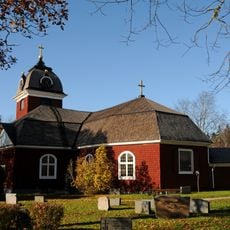
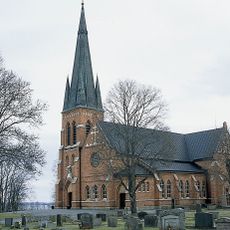
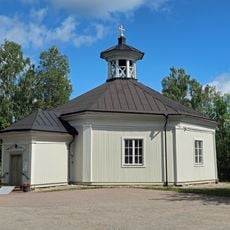
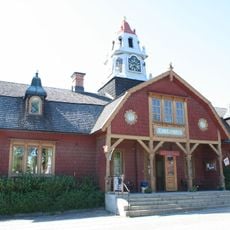
Ljusnarsberg Church is a timber church with facades clad in red-painted wood shingles, a straight chancel to the east, a west tower, transepts to the north and south, and a sacristy east of the chancel. Several spires rise from the different parts of the building, and a roof lantern sits over the crossing. A tarred bell tower from the 1640s stands northwest of the cemetery.
A wooden chapel was raised in 1635–1637 for miners and Forest Finn settlers drawn to the nearby copper works; it was consecrated in November 1635 before completion. In 1691–1696 the building was cut apart and rebuilt as a cruciform church with transepts and the choir moved east. Fritz Eckert designed the 1891–1892 choir and sacristy, and the church was reconsecrated on 11 September 1892.
The church keeps furnishings that record local donors and craftsmen: the 1644 limestone font is carved as a priest in vestments, and the 1643 pulpit was made by Lars Strångesson. Northwest of the cemetery stands a tarred bell tower from the 1640s, partly clad in wood.
The church stands in Kopparberg, with the tarred bell tower of the 1640s northwest of the cemetery. The west tower is visible from a distance and marks the main approach. A ramp and accessible toilet were added in the 2013 extension to the west, and the exterior shingles and tarred roofs were renewed in 2002.
The church combines traditional Swedish wooden building methods at an unusually large scale, setting it apart from the smaller chapels found elsewhere in the region. This size difference makes it a standout example of religious architecture in central Sweden.
The community of curious travelers
AroundUs brings together thousands of curated places, local tips, and hidden gems, enriched daily by 94,474 contributors worldwide.