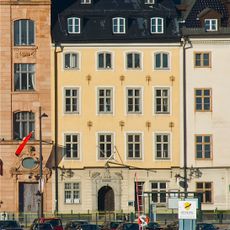
Logården, Royal garden at Stockholm Palace, Sweden
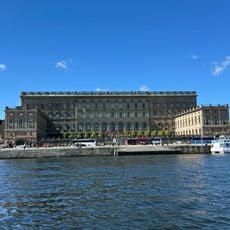
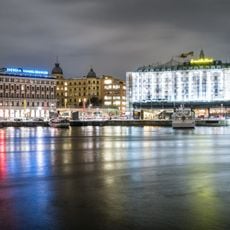
Logården is the garden courtyard of Stockholm Palace, set between its south-east and north-east wings and facing Skeppsbron and the Baltic. Since the 1922–1930 rebuilding it is an open paved area with a central walk from the east archway to Skeppsbron, flanked by shallow water mirrors. Two marble amphorae imported by Gustav III stand here, 1.70 m tall without their granite plinths.
In 1798 the site was laid out as the "Kungl. Slottsträdgården", a miniature English park designed by Fredrik Magnus Piper. Between 1922 and 1930 it was rebuilt from that park into today's more open surface with water mirrors on either side of the path from the east vault to Skeppsbron. The surrounding Logårdsmuren wall and iron fence, designed by Axel Magnus Fahlcrantz, were erected in 1820–1822.
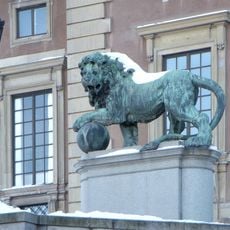
The name may come from a former animal enclosure: wolves, lynxes, foxes and even lions were kept in the courtyard, as in the old Tre Kronor castle's Lejongården. Another reading traces it to a "lodgård" where the artillery stored cannonballs, called "lod", before the word became Logården.
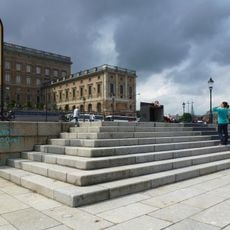
Logården lies between the palace's south-east and north-east wings, opening onto Skeppsbron and Saltsjön; the Logårdstrappan leads up from the palace jetty, where boat-borne guests are received. The garden was rebuilt 1922–1930 into an open surface with water mirrors on either side of the path from the east vault. The Logårdsbarriären, a baluster barrier of Stockholmsgranit by Axel Magnus Fahlcrantz, was erected 1820–1822.
The two marble amphorae in Logården are 1.70 m tall, excluding their granite plinths, and about 0.75 m across at the widest point. Gustav III imported four from Italy for Hagaparken in Solna; two remain there, and these two ended up at the palace.
The community of curious travelers
AroundUs brings together thousands of curated places, local tips, and hidden gems, enriched daily by 93,453 contributors worldwide.