Saint George and the Dragon in Storkyrkan, medieval wooden sculpture in Storkyrkan, Stockholm, Sweden
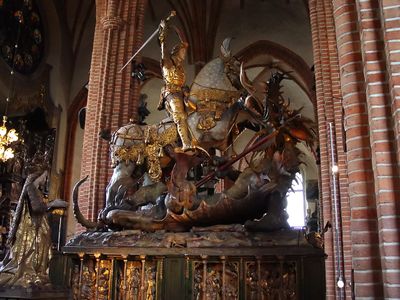
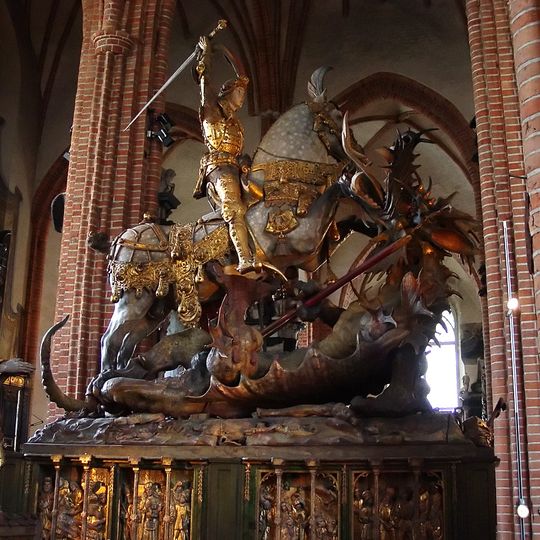
Saint George and the Dragon is a late medieval wooden sculpture in Storkyrkan, Stockholm. The main group is 3.75 metres tall and stands on a wooden plinth, making the total height about 6 metres. It shows Saint George on a rearing horse, his lance broken, raising his sword over a winged dragon twisted on a rocky mound; the horse's harness bears a gold cross and the saddle cloth shows three water-lily leaves, the Sture family emblem.
Sten Sture the Elder commissioned the sculpture after his victory over the Danish army at the Battle of Brunkeberg in 1471, placing his army under Saint George's protection. It was inaugurated in Storkyrkan on New Year's Eve 1489 by a papal nuncio. The work is widely attributed to Bernt Notke's Lübeck workshop, though its origin remains debated. It later served as Sten Sture's funerary monument, and his heraldic insignia appear on the sculpture.
The work illustrates the medieval legend of Saint George, a popular chivalric theme in Scandinavia. The saint's plume feathers are blue and yellow, the Swedish national colours, and the horse's harness shows three water-lily leaves from the Sture family arms. On 10 October the figure of Saint George was carried in procession to the site of the Battle of Brunkeberg.
Visitors can see the sculpture inside Storkyrkan Cathedral located in Stockholm's Old Town. The work is on permanent display within the church and can be viewed during the building's regular opening hours.
The wooden structure was intentionally carved hollow to prevent cracking and preserve the work through centuries. This technique reveals the advanced knowledge medieval craftspeople had about how wood behaves and lasts over time.
The community of curious travelers
AroundUs brings together thousands of curated places, local tips, and hidden gems, enriched daily by 93,753 contributors worldwide.