Årsta gård, Historical manor in Årsta, Sweden
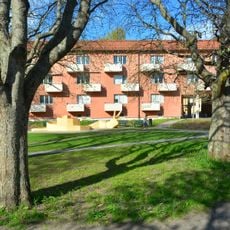
Årsta gård is a manor house at Svärdlångsvägen 16 on the south side of Årstaviken in the Årsta district of Stockholm. The main building is a rendered stone house with a timber frame beneath the plaster, rebuilt in 1795 when the frontispieces were added; its foundation is older, probably medieval. A grain store from the late 18th or early 19th century also survives.
Årsta gård is first mentioned in 1344 among Uppsala Cathedral's properties, donated by Duke Valdemar Magnusson. In the 1430s Hans Kröpelin owned it, and through marriage it passed to the Oxenstierna family for 150 years. Jakob De la Gardie and Ebba Brahe held it in the 17th century. In 1905 Fredrik Rappe sold the estate to Stockholm city, and farming continued until the 1940s.
The name Årsta comes from Arusboar, meaning those who live by the river mouth, referring to Valla å where it met Årstaviken. The estate is best known through Märta Helena Reenstierna, "Årstafrun", whose diaries from 1793–1839 describe manor life and were published as Årstadagboken. Since 1958 the main building has housed Årsta särskola, a special school.
The property sits near Enskede Gård T-Bana station and is accessible by Stockholm's public transit year-round. Getting there is straightforward, and the surrounding neighborhood offers comfortable walking paths.
The main building hides a medieval stone core under plaster added in 1795, when the two front gables were built. An older oak-timber manor, said to be cut on Södermalm and linked by tradition to Birger jarl, stood until 1815. The grain store from around 1800 is the only other older building left.
The community of curious travelers
AroundUs brings together thousands of curated places, local tips, and hidden gems, enriched daily by 94,019 contributors worldwide.