Årstabroarna, Railway bridge complex in Stockholm, Sweden.
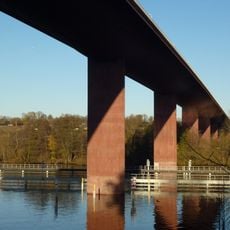
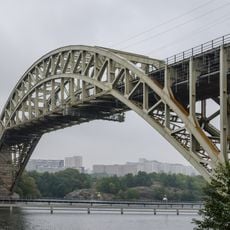
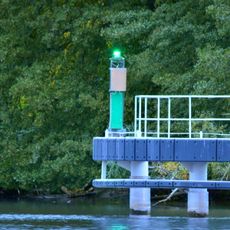
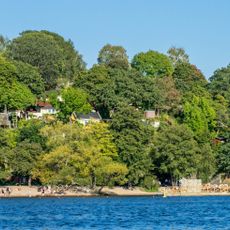
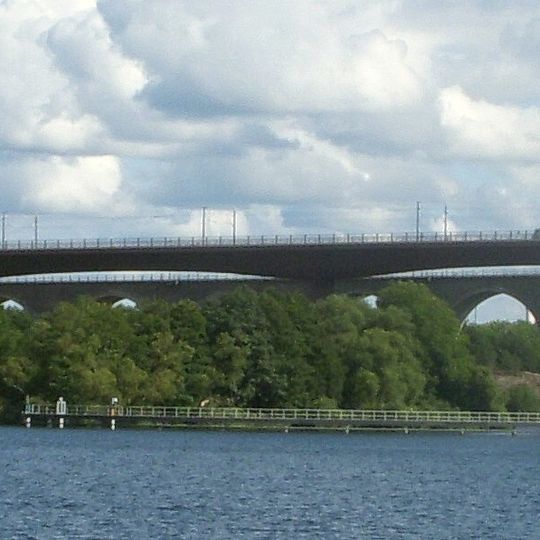
Årstabroarna consists of two parallel railway bridges over Årstaviken and the islets Årsta holmar, linking Södermalm to Årsta. The eastern bridge, 753 metres long and 9 metres wide, has 20 concrete arches and a 150-metre steel truss span; the western bridge, 833 metres long and 19.5 metres wide, is supported by ten slender pillars. Only the western bridge has a walkway and cycle path.
The first railway link across Årstaviken opened in 1860 as a low embankment with a swing bridge. The present eastern bridge, built 1923–1929, was designed by Cyrillus Johansson with engineers Ernst Nilsson and Salomon Kasarnowsky; its 20 concrete arches and a 150-metre steel truss span made it Sweden's longest bridge. The western bridge, designed by Norman Foster, opened in 2005.
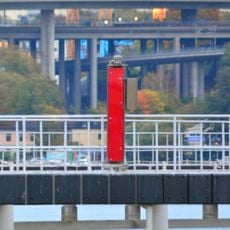
The western bridge's concrete was pigmented with iron oxide, giving it a deep red colour that critics likened to falu sausage, so it was nicknamed 'falukorven'. The name stuck and is now used locally for the 2005 bridge. The eastern bridge, by contrast, is often compared to a Roman aqueduct.
Crossing is easiest during daylight hours, with dedicated pedestrian and cyclist pathways ensuring safety away from rail traffic. Plan your visit outside peak rail hours to fully enjoy the crossing and the views across the water.
The eastern bridge's 20 concrete arches were cast using a movable formwork supported by brackets on the piers; four brackets on each pier face were left in place and are still visible. Its lift span over the northern passage was locked and welded in the lowered position on 23 February 1973, after having been raised only a few times a year in the 1960s.
The community of curious travelers
AroundUs brings together thousands of curated places, local tips, and hidden gems, enriched daily by 93,693 contributors worldwide.