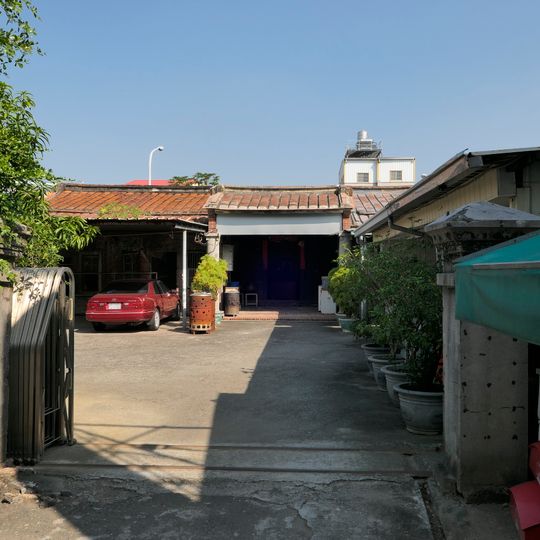
Old House of Su Family, Taiye, Traditional residential house in Taiye Village, Taiwan
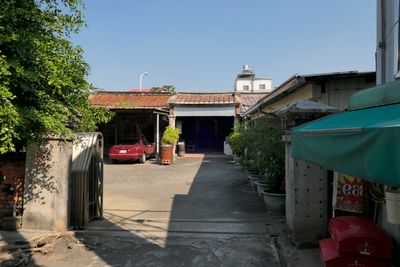
The Old House of Su Family, known as Taiye Su Family Old House, is a two-courtyard, double-wing residence facing south, with a five-bay front and rear hall, two-bay inner wings and thirteen-bay outer wings. It measures about 40 meters east-west and 100 meters north-south. The inner courtyard is paved with red bricks and has an old well. The east wing gate bears the ink inscription "Su Yingyuan Family" on white tiles, and the west wing "Su Yinghong Family", both written by Su Wenzhi in 1932.
The house was built before 1850 by Su Zu, who had been buying land from his nephew since the Qianlong era; some accounts place construction after 1778. In October 1895, during the Yiwei War, Japanese general Nogi Maresuke stayed in a small room left of the main hall, and Pastor Barclay met him here to arrange Tainan's peaceful surrender. A Japanese researcher investigated the episode on site in 1936.
The eastern wing's gate bears the ink inscription "Su Yingyuan's House" and the western wing "Su Yinghong's House", both written by Hu Nei village head Su Wenzhi in 1932 and fired as tiles in Tainan; the white background with black characters was chosen to break superstition. Descendants of the eastern wing mostly farmed, while the western wing produced a doctor and entrepreneurs during the Japanese era. A family account holds that a craftsman's curse on the wings was removed only from the west in time.
The compound measures about 40 metres east-west and 100 metres north-south, with a wide red-brick inner courtyard holding an old well. The east second row of side halls and the orchard have been rebuilt as modern buildings, so the older fabric is best seen in the front and rear halls and the inner side halls.
The east wing's gate bears the ink inscription "Su Yingyuan's House" and the west wing "Su Yinghong's House", both written by village head Su Wenzhi in 1932 and fired as tiles in Tainan. White characters on a black ground were chosen to break a superstition. Descendants say Nogi Maresuke rode a horse in the central courtyard in the mornings, and hoof marks could once still be made out there.
The community of curious travelers
AroundUs brings together thousands of curated places, local tips, and hidden gems, enriched daily by 95,355 contributors worldwide.