Yalpug Lake, Natural lake in Odesa Oblast, Ukraine.
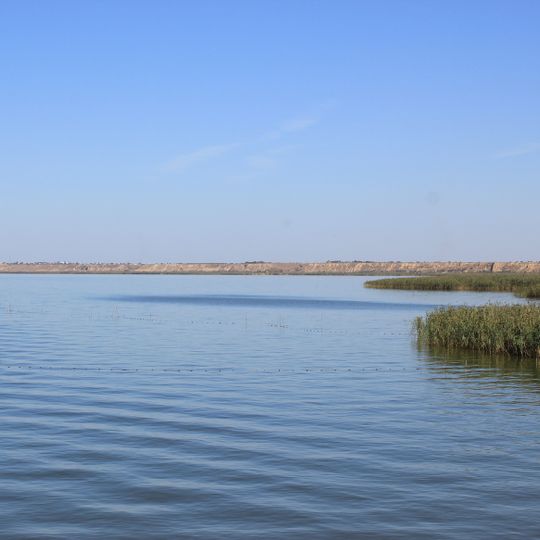
Yalpug Lake is a freshwater liman-type lake stretching 39 km north to south and up to 6 km wide, with an average depth of about 2 m. Its northern end, where the Yalpug River enters, is marshy and overgrown with reeds; the eastern and western banks are elevated and cut by ravines, while the southern shores are sandy. A dam with a bridge in its middle, built in the 1970s, crosses the channel linking it to Lake Kugurluy.
Yalpug first appears in records in 1445 and 1448. Its basin formed when Danube floods filled the floodplain of the Yalpug River, a left tributary of the Danube, as Black Sea levels stabilised over recent millennia. In the 1970s a dam with a bridge was built across the channel to Lake Kugurluy, carrying the Izmail–Reni road; it cut water exchange between the two lakes by nearly a third.
The lake's name likely comes from a Turkic word meaning "wide" or "shallow," linked to the Cumans; the Nogai Tatar explanation derives it from jalpyh, "sugary," for the white shores. Bolgrad, founded in 1821 by Bulgarian settlers, lies at the mouth of the Yalpug River on the north shore. The lake supplies drinking water to Bolgrad and nearby villages and is used for fishing and recreation.
Bolgrad sits at the northern tip of the lake where the Yalpug River enters. The dam at the southern end carries the Izmail–Reni road, with a bridge at its midpoint. Water levels drop markedly in summer, and the northern shore near the river mouth is marshy and overgrown with reeds.
The Yalpug River rises in Moldova's Codru hills at 300 m and enters the lake at Bolgrad; its water is now the main source of pollution in the lake's shallow northern part, where mineralisation is far higher than in the south near the Danube.
The community of curious travelers
AroundUs brings together thousands of curated places, local tips, and hidden gems, enriched daily by 94,630 contributors worldwide.