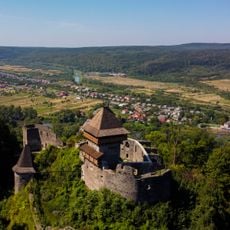
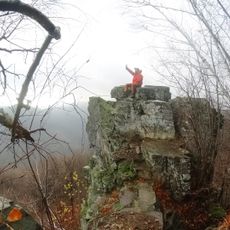
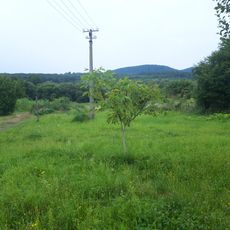
Serednie Castle, Medieval fortress in Serednye, Ukraine.
Serednie Castle consists of a single square stone donjon measuring 18.6 by 16.5 metres, with walls 2.6 metres thick and a height of 20 metres. Its entrance was placed on the second level of the east wall, reached by a wooden ladder that could be removed in danger. The first level held two rooms, 11.2 by 6 metres, divided by a 1.3-metre wall with an 80 cm doorway; a stone-filled pit in the floor may have been a well.
Archaeological digs from 2008 by Uzhhorod National University, led by Ihor Prokhnenko, found no artefacts older than the 15th century and could not confirm the 12th-century date; the castle was probably built in the late 15th or early 16th century, which refutes the Templar legend. In 1312 it passed to the Order of Saint Paul, and in 1526, after the Battle of Mohács, it went to the Dobó family. István Dobó and his sons strengthened it and expanded the wine cellars with Turkish prisoners of war.
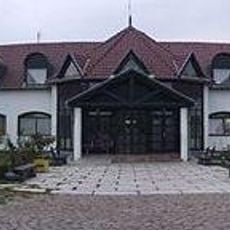
The castle's name comes from the village of Serednie, and its wine cellars are still used by the local winery Leanka. A stone tablet carved 550 years ago records that Francisk Stefan and Dominik Dobo, heirs and owners of the castle, had the cellar strengthened with loopholes and a moat in 1557; a wooden board nearby gives the translation.
The castle stands on the plain in the centre of Serednye, not on a hill, so it is reached on foot from the village streets. The site is an unkempt ruin with uneven ground and no garrison; the first conservation work was carried out in 1972. The wine cellars linked to the Dobó family, about 4 km long, are used today by the local Leanka winery.
The greatest damage to the castle came not from sieges but from local residents, who dismantled the walls left without a garrison and used the stone as building material for the foundations of their houses.
The community of curious travelers
AroundUs brings together thousands of curated places, local tips, and hidden gems, enriched daily by 94,044 contributors worldwide.