Dolha Castle in Dovhe, castle in Ukraine
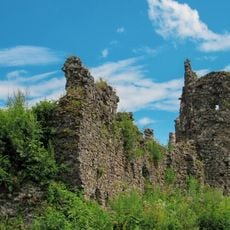
Dolha Castle in Dovhe is a stone fortress in a small village within Zakarpattia Oblast. The structure features thick walls, towers with narrow windows, and an open courtyard with remnants of wooden beams and aged stonework that reveal its centuries of standing.
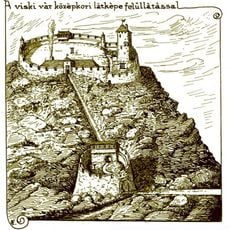
Dolhay Ambrus received royal permission in 1460 to build a stone house, but erected a castle instead; the diet ordered its demolition in 1471. The present palace-fortress was rebuilt from 1712 by Count László Teleki, after Emperor Charles III granted the Dolha estate to the Teleki family. The gate tower was completed in 1774 and construction finished in 1798. From 1920 a district hospital occupied the building, and since 1954 it has housed a tuberculosis clinic.
The castle bears the name of the Dolhay family, whose coat of arms was carved above the gate tower and printed in an 1880 armorial of Hungarian towns. After the family died out in 1708, the estate passed to the Teleki counts, and the gate tower still carries the village coat of arms. Since 1954 the grounds have housed a tuberculosis hospital.
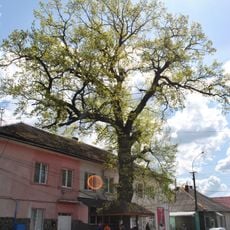
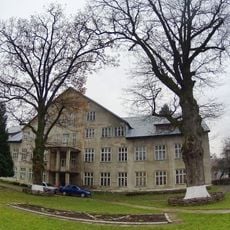
The palace-fortress stands in the centre of Dovhe, a short walk from the turul bird monument, in the Borzha valley 28 km from Ilosva. It has housed a tuberculosis clinic since 1954, so the buildings are not open for tours; the 65×65 m walls, corner bastions and 1774 gate tower are seen from outside. Two lime trees in the courtyard, one over 600 years old with a 6 m girth, are a protected natural monument.
The gate tower bears the village coat of arms carved directly above it, a motif also recorded in an 1880 armorial of Hungarian towns. In the courtyard stand two old lindens; one is estimated at over 600 years, with a girth of 6 m and a height of 25 m. Beneath the palace lie remains of an earlier building, possibly a noble house of the 15th to 18th centuries.
The community of curious travelers
AroundUs brings together thousands of curated places, local tips, and hidden gems, enriched daily by 94,712 contributors worldwide.