Old Salem, Open-air museum in Winston-Salem, North Carolina.
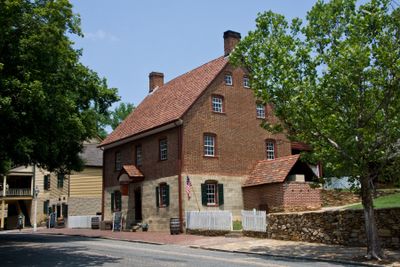
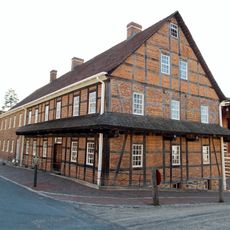
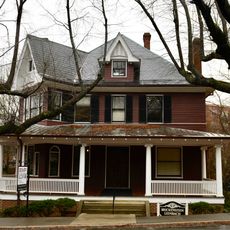
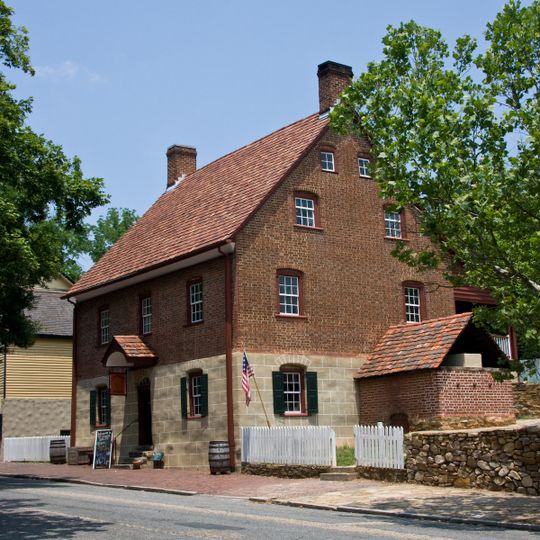
Old Salem is a restored Moravian town within Winston-Salem, North Carolina, centred on Salem Square, which is bounded by Academy, Church, West and Main Streets. About 70% of the district's buildings are original, among them the Salem Tavern and the Single Brothers' House, both individually designated National Historic Landmarks. The Michael Brown House shows the local manner: a red-brown brick upper storey with a steep red-tiled gable roof and two chimneys, set over a pale stone or stucco ground floor with shuttered windows and a central door.
Moravians from Bethlehem, Pennsylvania, bought just over 98,985 acres in the North Carolina Piedmont in 1753 and founded Bethabara in 1753 and Bethania in 1759 before starting Salem in 1766 as the central town of the Wachovia tract. The church owned all property and leased land for construction until the Salem Congregation bought the 5-square-mile town lot outright in 1826. In 1849 Salem refused to become the seat of the new Forsyth County, so the courthouse town of Winston grew just north; the church divested control in 1857, and the two towns merged in 1913.
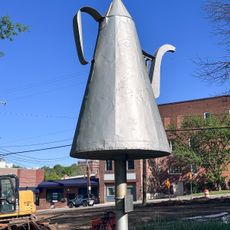
Old Salem's story is told through its craftsmen: tinsmiths, blacksmiths, cobblers, gunsmiths, bakers and carpenters work in the restored buildings and talk with visitors as they practise their trades. The town is centred on Salem Square, where concerts and other events are held through the year, and the Moravian sunrise service at Easter draws thousands. A large tin coffee pot, made by Julius Mickey in 1858 as a sign for his tinsmith shop, has long stood for the town.
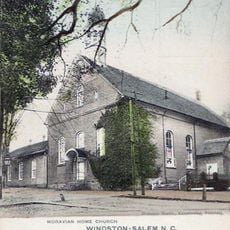
Old Salem spreads around Salem Square, bounded by Academy, Church, West and Main streets, with Salem College on the square's east side. Buildings are split among Old Salem, Inc., the Wachovia Historical Society, Salem College, Salem Academy and Salem Congregation, so some houses are private and only viewed from the street. The Home Moravian Church, just outside the historic district, opens to visitors during the tourist season.
The tin coffee pot made by Moravian tinsmith Julius Mickey in 1858 stood at the corner of Belews and Main Street, marking the line between Winston and Salem. After the towns merged in 1913 it became a symbol of union; in 1920 a car knocked it from its place, and the city had it removed despite local protests.
The community of curious travelers
AroundUs brings together thousands of curated places, local tips, and hidden gems, enriched daily by 94,713 contributors worldwide.