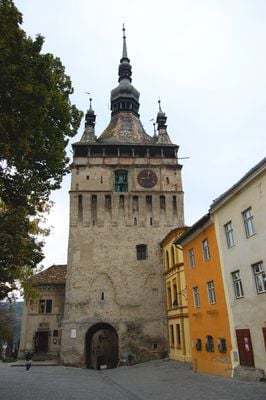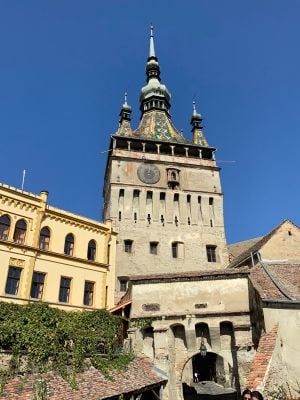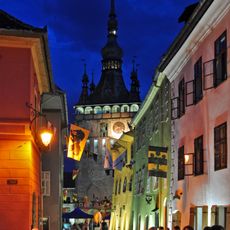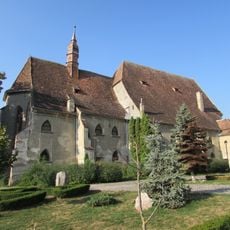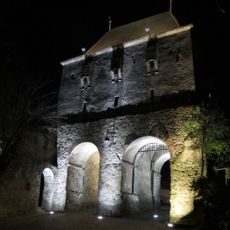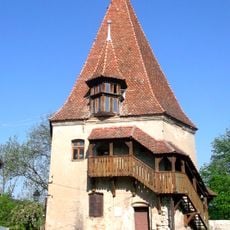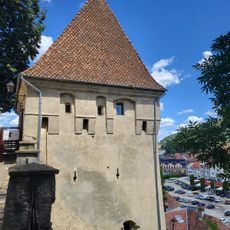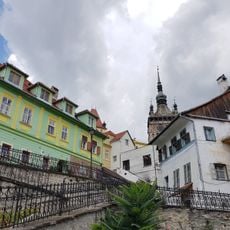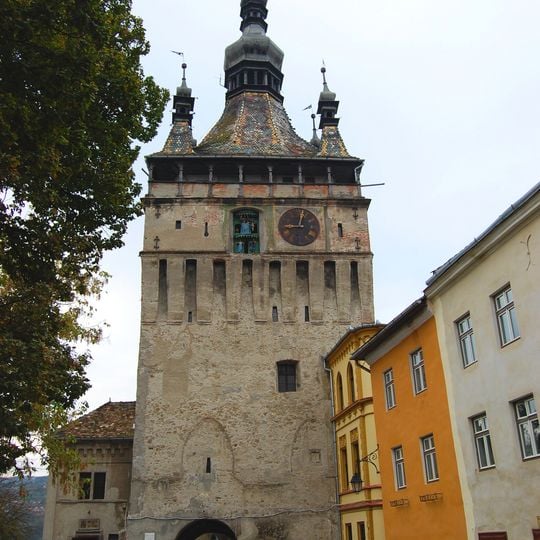
Clock Tower of Sighișoara, Clock tower in Sighișoara, Romania.
The Clock Tower of Sighișoara is a 64-meter rectangular prism with a base of 12 by 8.66 meters, five levels, a balcony and a pyramidal roof. Its steep patterned-tile roof, flanked by four 12.5-meter corner turrets, rises 34 meters above the 30-meter tower body. Two clock dials of 2.3 meters diameter face the upper and lower city, and two vaulted passages cross the ground floor.
Construction began at the end of the 13th century as a simple gate tower of sandstone and river rock, completed in the 14th century with at most two upper levels and a 2.35-metre-thick base. In the 16th century the old roof was demolished and two brick floors plus a balcony were added. After the fire of 1676, three travelling masters rebuilt it from March to September 1677 for 650 florins, giving it the present Baroque roof with five turrets.
The tower holds mechanical figures representing days of the week, ancient gods, and planets that rotate at midnight in specially designed niches.
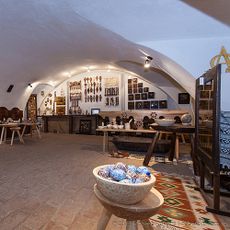
The tower is the main entry point to the walled upper city, standing opposite the Tailors' Tower, and two vaulted passages cross its base. The balcony is the city's chief observation point, with a wide view over the citadel and the lower town. The History Museum has occupied the building since 1898.
The four corner turrets, each 12.5 metres high, signalled that the local judge could pass and carry out death sentences. A golden sphere one metre in diameter tops the roof. A copy of the tower stands in Budapest's city park as the Apostles' Tower beside Vajdahunyad Castle, designed by Ignác Alpár.
The community of curious travelers
AroundUs brings together thousands of curated places, local tips, and hidden gems, enriched daily by 93,095 contributors worldwide.