Brandenburg Gate, Medieval city gate in Kaliningrad, Russia.
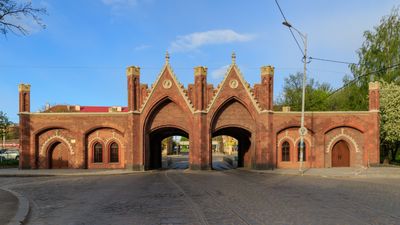
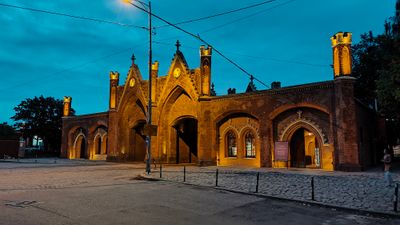
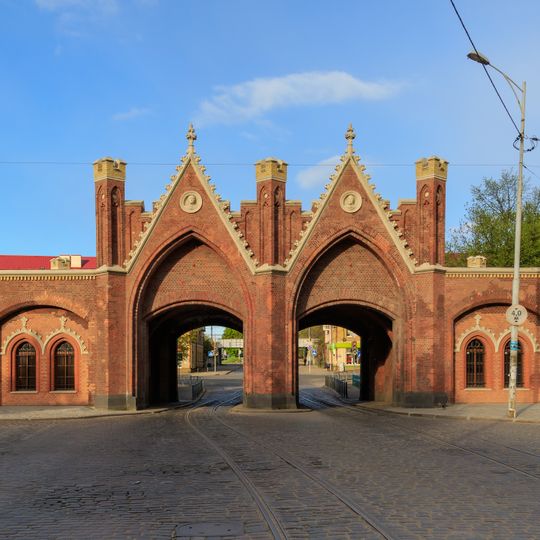
The Brandenburg Gate is a neogothic brick city gate on Bagration Street in Kaliningrad, built in the mid-19th century. It has two pointed-arch passages framed by steep stepped gables with round medallions and pinnacled piers, and lower side wings with smaller arched windows. Sculpted portraits of Field Marshal Hermann von Boyen and Lieutenant-General Ernst von Aster are mounted on the gate.
The first gate, built in 1657 on the road to Brandenburg Castle, was a wooden structure backed by a moat. King Frederick II of Prussia had it replaced by a brick gate with two pointed-arch passages. The 1843 restoration gave it its present form, adding stepped gables, medallions and portrait sculptures of Field Marshal Hermann von Boyen and Lieutenant-General Ernst von Aster.
The gate carries sculpted portraits of two Prussian officers: Field Marshal Hermann von Boyen (1771–1848), a war minister and army reformer, and Lieutenant-General Ernst von Aster (1778–1855), chief of the engineering corps and a planner of the city's second wall. The gate's name comes from the road that ran from here to Brandenburg Castle, now the village of Ushakovo.
The gate stands on Bagration Street and remains open to vehicle traffic, so visitors should watch for cars when approaching. The location sits roughly 500 meters from the Southern Railway Station, making it walkable to reach.
The Marzipan Museum occupies rooms inside the gate; its sign, "Музей Марципана", is visible beside the right-hand arch. Exhibits show marzipan figures and models of Königsberg landmarks, and the gate's two sculpted portraits, of Hermann von Boyen on the left and Ernst von Aster on the right, are easy to miss above eye level.
The community of curious travelers
AroundUs brings together thousands of curated places, local tips, and hidden gems, enriched daily by 93,099 contributors worldwide.