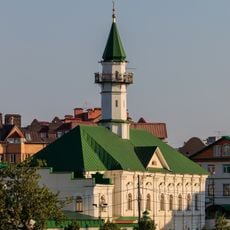
Blue Mosque, Qazan, Mosque in İske Bistä district, Qazan, Russia.
The Blue Mosque (Zəŋgər məçet) is a two-storey, two-hall Friday mosque in the Staro-Tatar Sloboda of Kazan, built in classicism by an unknown architect. Its walls give the building its name, and a three-tier minaret rises from the roof. The facade was lengthened by three windows in 1864, and the mihrab section was enlarged in 1907.
A wooden mosque stood on the site from 1778, the fourth congregational mosque in Kazan, serving a community known as the "makhalla of slaves". In 1815 the old building was moved to the village of Suyksu, and between 1815 and 1819 the merchant Akhmet Aitov-Zamanov funded a stone mosque in the classicist style. The merchant G. B. Mustakimov extended the facade by three windows and added a fence in 1864, and G. A. Ishmuratov enlarged the mihrab in 1907. Closed by decree on 10 March 1932, the minaret was dismantled in the 1930s and only rebuilt in 2009.
This mosque serves as a gathering place for the Muslim community in Tatarstan and welcomes visitors during non-prayer times. The building anchors daily religious life in the İske Bistä neighborhood and remains central to local worship practices.
The mosque is located near Sara Sadıyqova and Fatix Kärim streets and welcomes visitors when prayers are not in session. Plan your visit around the prayer schedule and dress respectfully to honor the sacred space.
The mosque's parish was known as the "maharlya of slaves", likely because the poorest Muslim population of Staro-Tatarskaya Sloboda lived in this part of the settlement. The first wooden mosque on the site, built in 1778 on the grounds of a former threshing floor, was the fourth mosque in Kazan; in 1815 it was moved to the village of Suyksu to make way for the stone building.
The community of curious travelers
AroundUs brings together thousands of curated places, local tips, and hidden gems, enriched daily by 94,089 contributors worldwide.