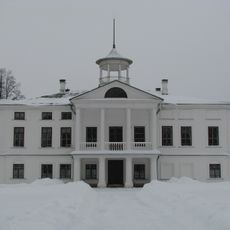
Lokalov House, Heritage estate in Velikoe, Russia.
Lokalov House is a two-storey mansion in the village of Velikoe, built in the Russian Revival style with a terem-like form. Its central risalit ends in a three-lobed arch, the ground floor is finished with diamond rustication, and the upper floor carries coloured tiles and small stained-glass windows. A tent-shaped tower with a weathervane rises over the entrance.
Merchant A. A. Lokalov commissioned the estate in the mid-1880s from F. O. Shekhtel, then a young architect without a diploma after his expulsion from the Moscow School of Painting, Sculpture and Architecture. Construction ran from 1888 to 1890, but Lokalov died a year after completion and the property passed to his daughters. Nationalized in 1918, it housed a provincial museum from 1919 to 1926, later a youth club, and from 1942 a children's home.
The house is now occupied by the Velikoselskoye orphanage, which has used the estate since 1942, when it was founded for children evacuated from besieged Leningrad. The name comes from the merchant A. A. Lokalov, who commissioned it. Visitors who get inside can look for the Soviet hammer and sickle painted on a second-floor ceiling, added long after the 1890s interiors.
The estate stands in the village of Velikoe, Gavrilov-Yamsky District, Yaroslavl Oblast. The main house is occupied by the Velikoselsky orphanage, so it is not open to visitors; the building is in a dilapidated state and awaits restoration. The surviving wrought-iron fence and gate pillars can be seen from the street.
The village of Velikoe was known in the 19th century for its linen trade, and the fortune behind the construction of this house came directly from that industry. The building is therefore not only an example of Revival architecture but also a tangible trace of a local economy that no longer exists.
The community of curious travelers
AroundUs brings together thousands of curated places, local tips, and hidden gems, enriched daily by 94,070 contributors worldwide.