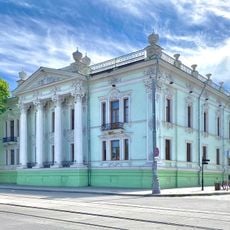
Alexandrovskiye Trade Rows, Neoclassical commercial building in Taganrog, Russia.
Alexandrovskiye Trade Rows is a 19th-century ensemble of two identical single-storey buildings whose concave facades form continuous arcaded galleries on austere Doric columns, split in two by Chekhov Street. Behind each column bay stood a shop with a door and two windows, a back door to a courtyard, and cellars entered from the high plinth. A continuous stair line and massive entablature crown the whole.
Construction of the trade rows took place in the 1840s to a design by the Italian architect M. Campinioni. The ensemble originally consisted of two identical single-storey buildings that half-enclosed Alexandrovskaya Square, now Red Square, and is split in two by Chekhov Street. In 1911 a two-storey leather-goods shop (Chekhov Street, 98) broke the right gallery's continuity; a bomb damaged the structure in World War II and many openings were bricked up.
The rows take their name from Alexandrovskaya Square, the former name of today's Red Square. Trade concentrated in the right-hand section, while the left side of Chekhov Street (No. 107–119) was let as lodgings. The rightmost stall by Red Lane was rented in 1874–1876 by Pavel Chekhov, father of Anton Chekhov; his uncle Ivan Loboda kept a shop there too.
The preserved sections continue to function as shops with original front doors and windows still in use. The cellars below and yard areas behind the shops may not always be open to the public.
The rightmost stall by Red Lane was rented by Anton Chekhov's father Pavel in 1874–1876; his uncle Ivan Loboda kept a shop there too. In 1921 a sculpture group "Union of Workers and Peasants" by Jan Navratil was placed above the former Chekhov stall and removed during repairs in 1966.
The community of curious travelers
AroundUs brings together thousands of curated places, local tips, and hidden gems, enriched daily by 94,001 contributors worldwide.