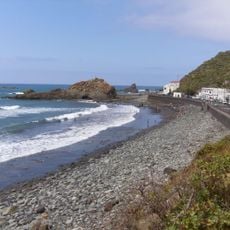
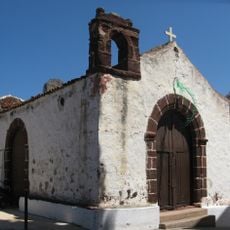
Roque Negro, Volcanic rock formation in Tenerife, Canary Islands, Spain.
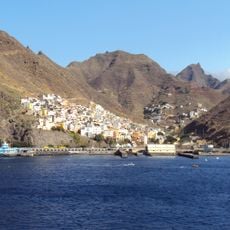
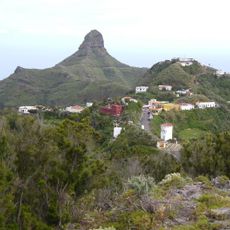
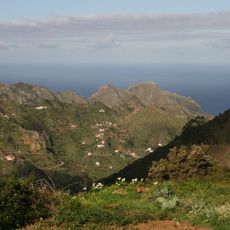
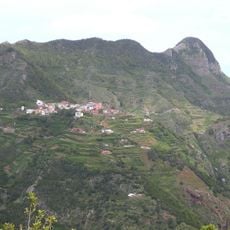
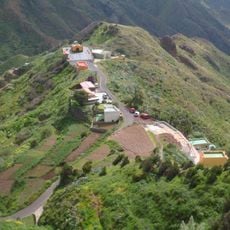
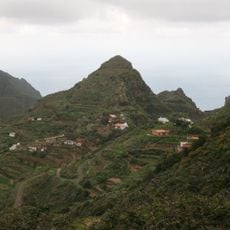
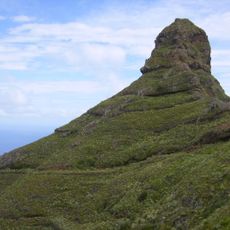
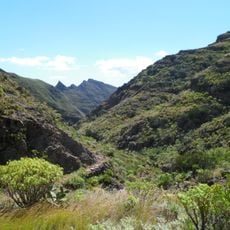
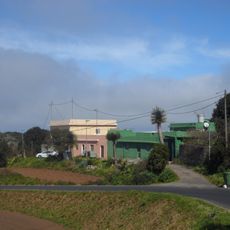
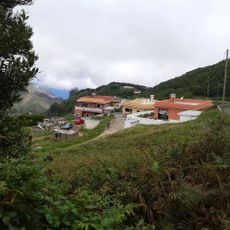
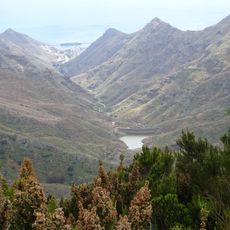
Roque Negro is a rural hamlet in the Anaga district of Santa Cruz de Tenerife, on Tenerife, made up of the nuclei Roque Negro, La Porquera, Pedro Martín, Perera and Lomo Bicho. It lies in the upper Afur valley at an average altitude of 590 m, and its landscape is dominated by a phonolitic rock elevation of 741 m that gives the village its name.
The hamlet took shape in the 18th century, when farmers from Afur claimed monteverde land belonging to the Cabildo and turned it into terraced fields. From its origin it was a pago of Taganana, and in 1877 both became neighbourhoods of Santa Cruz de Tenerife. From the early 20th century until 1981 it shared a pedáneo mayor with Afur, and in 1994 it was included in the Anaga Rural Park.
The hamlet's name comes from the 741-metre phonolitic rock that rises above it. Since 2008, residents have revived the Fiesta de las Lavanderas, in which women and girls reenact washing at the lavaderos built in 1897 beside the Roque Negro-Catalanes gallery. The village fiestas run from 30 August to 6 September in honour of Nuestra Señora de Fátima.
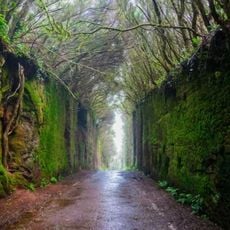
Roque Negro is reached by the TF-136 road, which replaced the track opened in the 1970s; the TF-12 does not serve the village. Long-distance trails PR-TF 2, PR-TF 2.1 and PR-TF 8 pass along its edges, and a self-guided trail explains the hamlet's ethnographic features. The core sits at about 590 m in the upper Afur valley, with lanes climbing between the five nuclei.
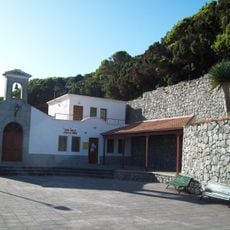
The village keeps a self-guided trail that explains the ethnographic values of the hamlet, and since 2013 a trail-running race of about fifteen kilometres starts and finishes on its plaza. The washing places built in 1897 beside the Roque Negro-Catalanes gallery are revived each year in the Fiesta de las Lavanderas, recovered by neighbours in 2008.
The community of curious travelers
AroundUs brings together thousands of curated places, local tips, and hidden gems, enriched daily by 95,075 contributors worldwide.