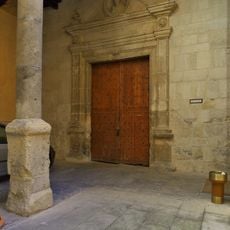
Iglesia de San Pedro, Cuenca, Gothic church in Cuenca, Spain.
Iglesia de San Pedro stands at the highest point of Cuenca. Its 18th-century rebuild by José Martín de Aldehuela encloses an octagonal plan within a circle, with pilasters and round arches, a dome on a drum with mixtilinear windows, and a tower of three diminishing sections topped by a bell body. The 1604 San Marcos chapel, later of the counts of Toreno, keeps a Mudejar octagonal coffered ceiling.
The church was probably built with three naves and a tower at the foot shortly after Alfonso VIII conquered Cuenca. In the mid-15th century its walls sheltered the supporters of bishop Lope de Barrientos during his struggle with Diego Hurtado de Mendoza, Marquis of Cañete. The medieval fabric changed little in the 16th century, but in the 18th century José Martín de Aldehuela rebuilt it on an octagonal plan, and it was restored after the Spanish Civil War.
The chapel of the counts of Toreno, finished in 1604 and once financed by the cathedral chaplain Miguel Enríquez, keeps a late-16th-century octagonal coffered ceiling in the Mudéjar tradition. The chapel later passed to the counts of Toreno, whose name it still bears.
The church stands at the highest point of Cuenca's old town, reached on foot through steep, stepped lanes. The tower was rebuilt from 1661 after threatening collapse, and its three diminishing bodies were topped with a bell stage in the late 18th century. Look up at the tower and the doorway before entering.
The tower was rebuilt after 1660: on 8 February 1661 the stonework was awarded to master Gregorio Pastor for 3,300 reales. The architect Juan del Pontón had insisted the spire be covered with tile rather than slate, and never with tinplate, which spoiled quickly.
The community of curious travelers
AroundUs brings together thousands of curated places, local tips, and hidden gems, enriched daily by 94,789 contributors worldwide.